

Product Field NotesCompanion Plants
Catching Fire Foamy Bells: Lime Leaves with a Red Flame Center
 Save
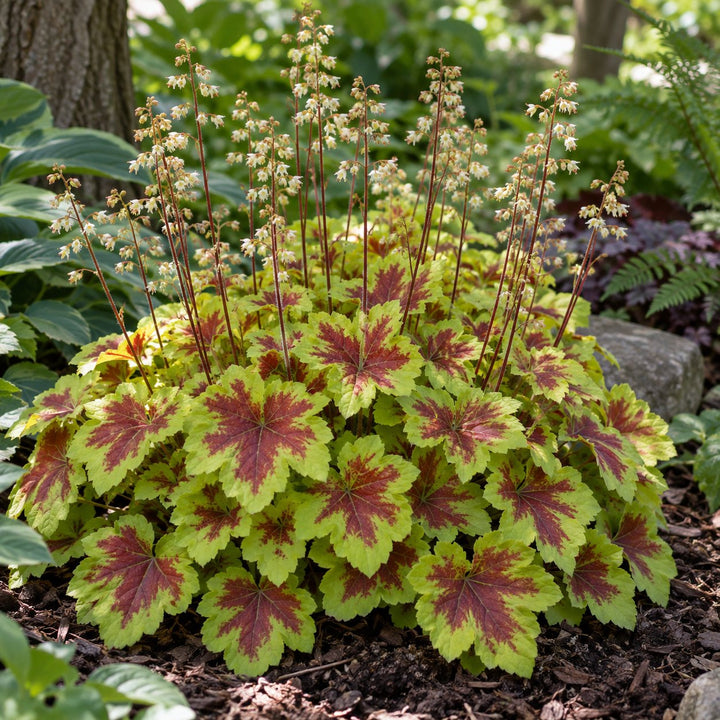
Catching Fire foamy bells has rounded, slightly cupped lime-green leaves, each marked at the center with a sharply defined cherry-red flame that flares out along the veins. Through summer the red deepens to mahogany, so the leaves keep a strong two-tone look from spring to fall.
It is a shade plant at heart. It will not share the lavender's sunny bed, but it can carry a splash of fire into the shady beds on the same property.
Catching Fire at a glance
| Trait | What to expect |
|---|---|
| Botanical name | × Heucherella 'Catching Fire' |
| Foliage | Lime green with cherry-red centers that turn mahogany by midsummer |
| Flowers | Slim sprays of cream on stems 16 to 20 inches tall |
| Size | 8 to 10 inches tall, 16 to 20 inches wide |
| Bloom | Starts early June, peaks mid-June |
| Hardiness | USDA zones 4 to 9 |
| Light | Full sun to full shade; best color in filtered sun or afternoon shade |
| Deer | Moderately resistant |
Planning it into a lavender garden
Foamy bells and lavender part ways on two points: light and water. Lavender wants full sun and dry, lean soil; Catching Fire looks best with some shade and steady moisture. So plant them in separate beds on the same plan, the lavender out in the open and Catching Fire under trees, along a shaded walk or by a north-facing wall.
In its shady bed, Catching Fire pairs beautifully with ferns and hostas, where its lime and red leaves stand out against plain greens. Because the mound is so dense and polished, it also looks great repeated in a long drift. Use the Companion Plant Planner to sketch the sun and shade parts of your garden together.
Planting and care
- Light: it handles more heat and sun than typical foamy bells, but filtered light keeps the color richest in hot summers.
- Soil: average to fertile, well-drained and evenly moist. Soggy soil leads to crown and root rot.
- Planting: keep the crown level with the soil surface.
- After bloom: the cream flowers are sterile and come in one flush. Cut the stems back once they fade.
- Winter: hardy in Michigan in well-drained soil. Mulch lightly after the ground freezes to prevent heaving; the foliage may brown in a hard winter, so trim damaged leaves in spring.
Watching the color change
Part of the fun of Catching Fire is that it does not hold still. Spring leaves open yellow to lime with a bright cherry center. By midsummer the flame has darkened to mahogany against the lime. Planted in a container on a shaded porch, it is a season-long show you can enjoy up close.
Two tray sizes
Catching Fire is offered as a 72-cell plug tray and a 20-cell plug tray. Pick the 72-cell tray for large plantings or potting up stock, and the 20-cell tray for bigger plugs that fill in faster. See each product page for current availability, or visit the Wholesale Hub.
Frequently asked questions
Why are my leaves fading?
Too much hot sun is the usual cause. Move it to filtered light or afternoon shade and keep the soil evenly moist.
Is it evergreen?
It holds its leaves through mild winters, but in a hard Michigan winter expect some browning. A spring trim tidies it up.

































Share how it went in your field