

Product Field NotesHerb Plants
Cinnamon Basil: Purple Stems and a Warm, Spicy Scent
 Save
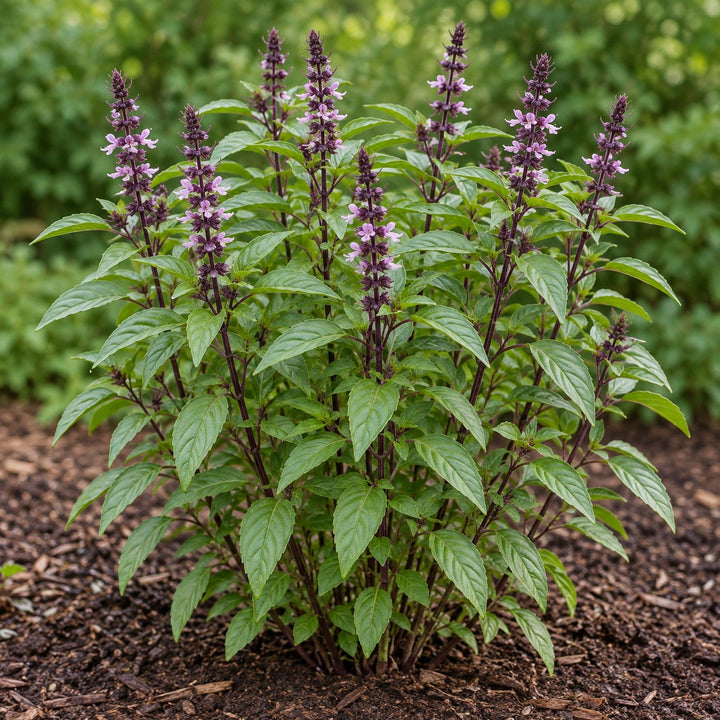
Cinnamon basil looks like a basil that dressed up for the evening. It has glossy dark green leaves with reddish-purple veins on purple stems, and from midsummer it sends up whorled spikes of purple flowers. Brush past it and you get a strong cinnamon scent layered over sweet basil.
It grows larger than everyday sweet basil, reaching 2 to 2½ feet, and it keeps flowering until frost if you let it.
Cinnamon basil at a glance
| Trait | What to expect |
|---|---|
| Botanical name | Ocimum basilicum 'Cinnamon' |
| Leaves | Dark green and glossy with reddish-purple veins, on purple stems |
| Flowers | Purple, in whorled spikes; edible |
| Size | 24 to 30 inches tall, 12 to 24 inches wide |
| Bloom | Starts mid-July, peaks mid-August, continuous |
| Hardiness | Grown as an annual; damaged below 50 F and killed by frost |
| Fragrance | Strong cinnamon over sweet basil |
| Deer | Resistant |
Growing it alongside lavender
Cinnamon basil loves summer heat, as lavender does, but it wants steady moisture, which lavender does not. The best arrangement is close by rather than in the same bed: a container on the sunny patio next to potted lavender, or the front of a kitchen herb bed where you can water the basil without soaking lavender crowns.
Visually, the two get along well. The purple stems and flower spikes pick up lavender's color, and the glossy dark leaves contrast with silver lavender foliage. Both bring in pollinators through midsummer. Plan the layout in the Companion Plant Planner.
Planting and care
- Timing: wait until nights stay above about 50 F. Cold nights stunt basil. Check timing with the Frost Date Estimator.
- Light and water: full sun and steady, moderate moisture.
- Pinching: pinch stem tips above a pair of leaves to make the plant bushy.
- Airflow: space plants apart. Basil downy mildew spreads in humid weather, and this variety is susceptible to it and to Fusarium wilt.
- End of season: it does not survive winter outdoors in zone 5-6. Harvest heavily before the first frost.
Using cinnamon basil
The leaves and flowers are both edible. Steep fresh leaves for a warm, spicy herbal tea, tear them over fruit salads, peaches or berries, or add them to soups and stews where a hint of spice is welcome. The purple flower spikes are pretty in a small vase or as a garnish, and the plant is rated good for cut stems.
For the best leaf flavor, pinch off flower buds as they form. If you would rather have flowers for bees and bouquets, let a few plants bloom and harvest from the rest.
Sizes offered
Cinnamon basil comes as 3-inch plugs, 4-inch pots and 1-gallon pots. Gallon pots are ready to harvest from sooner; plugs are the economical way to fill a bed. See the product page for current sizes and availability.
Frequently asked questions
Does cinnamon basil taste like cinnamon?
It has a strong cinnamon scent on top of a basil flavor, so it tastes like basil with a warm, spicy edge.
Can I use it in pesto?
You can, but its spice is strong. Many cooks prefer it in tea, fruit dishes and soups, and use sweet basil for classic pesto.
Will it come back next year?
No. It is frost-tender and is replanted each spring.

































Share how it went in your field