

Product Field NotesCompanion Plants
Denim 'n Lace Russian Sage: Lavender's Late-Summer Stand-In
 Save
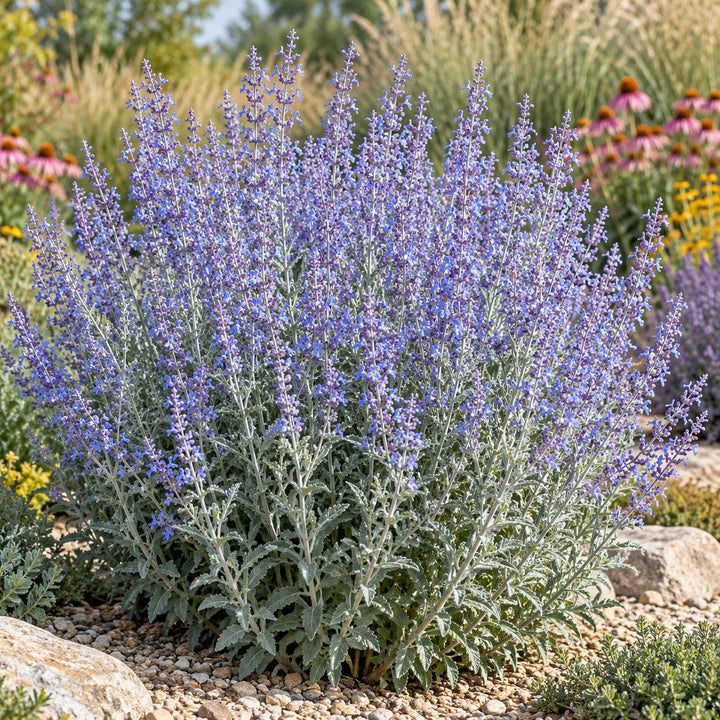
If any plant can pass for lavender's cousin from across the garden, it is Russian sage. Denim 'n Lace Russian sage carries dense, branching spires of tiny, lacy sky-blue flowers set in closely packed amethyst calyxes, over small, silvery gray-green leaves with a sharp sage-like scent. It is sized for real gardens, roughly 28 to 33 inches tall, and its sturdier stems stand straighter than many older types.
Denim 'n Lace at a glance
| Trait | What to expect |
|---|---|
| Botanical name | Salvia yangii 'Denim 'n Lace' (formerly Perovskia atriplicifolia) |
| Flowers | Sky blue on amethyst-purple calyxes |
| Foliage | Silvery gray-green, finely divided, sage-scented |
| Size | About 28 to 33 inches tall, 3 to 4 feet wide |
| Bloom | Starts mid-July, peaks mid-August, color lasts into fall |
| Hardiness | USDA zones 4 to 9 |
| Light | Full sun |
| Wildlife | Great for pollinators; deer resistant |
The perfect relay partner
Russian sage and lavender share almost everything: hot sun, lean soil, sharp drainage, silvery aromatic leaves and a soft blue-purple haze. What they do not share is timing, and that is the point. English lavender peaks in early summer; Denim 'n Lace starts in mid-July and peaks in mid-August, and because the amethyst calyxes stay colored after the flowers drop, it looks in bloom well into fall. Plant the two together and the silvery, blue-purple look carries from June to frost.
Its width matters in the layout. At 3 to 4 feet wide, it works best behind or between lavender groups rather than squeezed in a row. Give each plant its full space so lavender mounds keep their airflow. Try it in the Companion Plant Planner.
Care: mostly leave it alone
- Soil: lean to average and well drained. Rich, moist soil makes stems lanky and floppy.
- Water: water through the first season, then very little. It is one of the best perennials for hot, exposed sites.
- Deadheading: not needed.
- Pruning: do not prune in fall. In spring, once new growth appears, cut back to about 6 to 12 inches, just above the lowest new buds.
- Problems: rarely bothered by pests; root rot in wet, heavy soil is the main risk.
Cutting, drying and formats
The spires are good for both fresh and dried arrangements, and they look lovely mixed with dried lavender bundles. Brush the foliage and you will notice a sharp, herbal scent, quite different from lavender's sweetness. Denim 'n Lace is offered as a 72-cell plug tray and as a bare root plant. See each product page for current availability.
Frequently asked questions
Is Russian sage a lavender?
No. It is now classified in the salvia family group, not Lavandula, though the two look and grow alike.
Why is mine still bare in May?
Russian sage is slow to leaf out in spring. Wait for buds before cutting back, and do not give up on it early.
Can I cook with it?
No. It is grown as an ornamental and is not a culinary herb.

































Share how it went in your field