

Product Field NotesCompanion Plants
Delmarva Delight Japanese Iris: Blue and White for Damp Ground
 Save
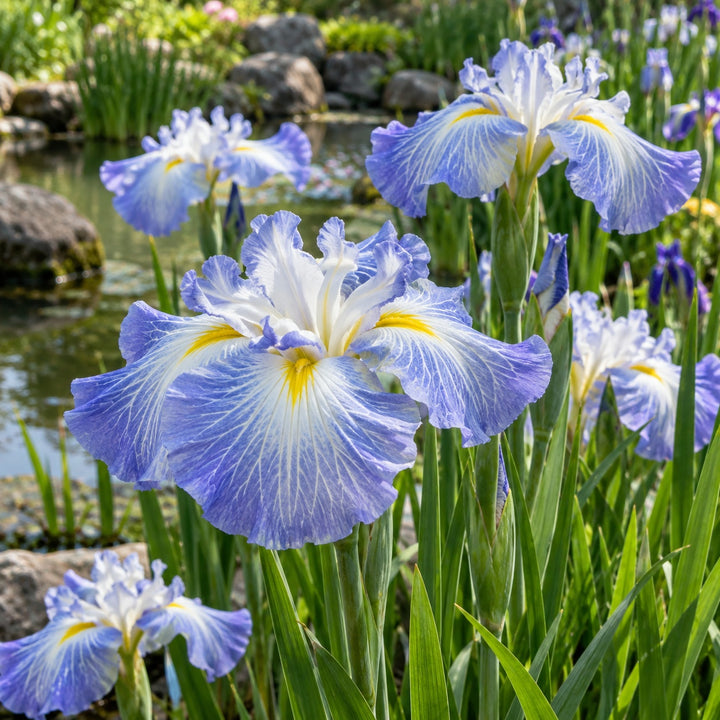
Delmarva Delight Japanese iris opens large, flat, lightly ruffled flowers that are white at the center and fade outward to soft blue at the edges, with fine white veining and a bright yellow signal at the base of each fall. The style arms in the middle are white tipped with blue. On slender 3-foot stems above sword-shaped leaves, it looks cool and crisp in the heat of early summer.
Delmarva Delight at a glance
| Trait | What to expect |
|---|---|
| Botanical name | Iris ensata 'Delmarva Delight' |
| Flowers | Double-form, white center shading to blue edges, yellow signal |
| Foliage | Mid-green, narrow and sword-shaped |
| Size | About 36 inches tall, 24 to 28 inches wide |
| Bloom | Starts mid-June, peaks late June |
| Hardiness | USDA zones 4 to 9 |
| Light | Full sun to part shade |
| Deer | Resistant |
The wet corner of a lavender garden
Almost every property has a spot where lavender will never live: the low area where water pools, the downspout outlet, the edge of a pond. That is exactly where Japanese iris thrives. Instead of fighting a soggy corner, plant Delmarva Delight there and let it hold the blue end of the garden's palette while the lavender holds the purple on higher, drier ground.
The timing lines up nicely. It blooms mid to late June, right as English lavender opens, so the whole property has a blue and purple moment at once. Use it as a specimen or in groups along water. The Companion Plant Planner can help you map wet and dry zones.
Planting and care
- Soil: rich, acidic to neutral and consistently moist. Avoid lime; Japanese irises decline in alkaline soil.
- Water: keep it moist from spring through bloom. Dry, hot sites brown the leaf tips and shorten the flowers.
- Winter water: pond edges are fine, but crowns should not sit underwater in winter.
- First winter: mulch new plantings to limit frost heaving.
- Cleanup: cut spent stems after flowering and clear dead foliage in late fall to remove iris borer eggs.
- Dividing: divide every three to four years in late summer to keep clumps vigorous.
For cutting
Delmarva Delight rates well as a cut flower. Cut stems when the first bud is just opening and the rest will follow in the vase. Its cool blue and white makes a calm arrangement with fresh lavender stems from the drier side of the garden.
It is offered as a bare root plant. Plant the rhizome just below the soil surface and water in well. See the product page for current availability.
Frequently asked questions
Can I plant it in a regular garden bed?
Only if you can keep the soil steadily moist through spring and early summer. Ordinary dry beds will disappoint it.
Is it safe for pets?
Iris rhizomes and leaves are irritating and can cause stomach upset if eaten, so plant it where pets will not chew it.
What does double-form mean?
It has six falls instead of three, which gives the flower its wide, flat, open look.

































Share how it went in your field