

Product Field NotesCompanion Plants
Desert Flame Daylily: Red-Orange Fire Behind Cool Lavender
 Save
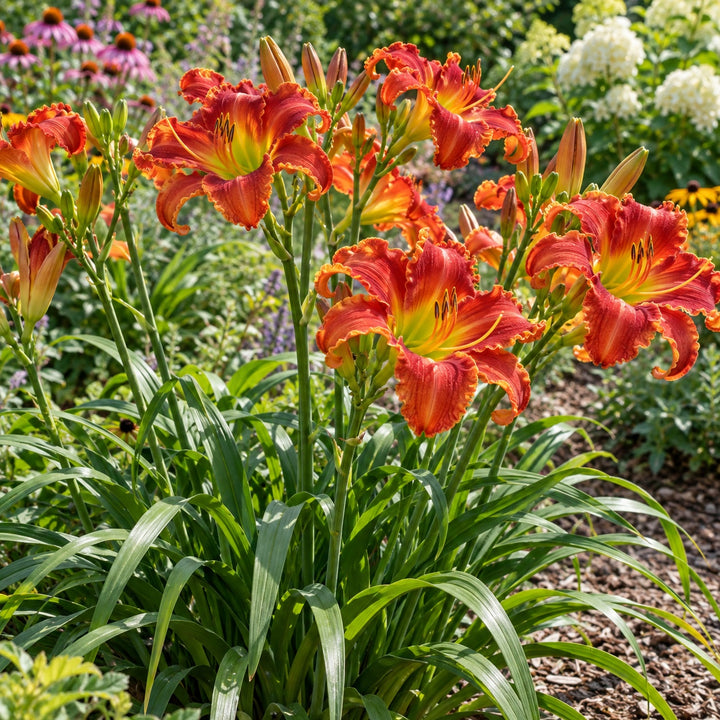
Desert Flame daylily does not whisper. Its 5½-inch flowers are a vivid, flaming red-orange with ruffled, recurved petals, a lime green throat and prominent orange stamens. They rise on branched scapes to about 36 inches, well above a fountain of arching green leaves, and they hold up through hot midsummer days.
Desert Flame at a glance
| Trait | What to expect |
|---|---|
| Botanical name | Hemerocallis 'Desert Flame' |
| Flowers | Flaming red-orange with a lime green throat, about 5½ inches |
| Foliage | Medium green, arching; dormant type |
| Size | Foliage about 22 inches; scapes to about 36 inches; 18 to 24 inches wide |
| Bloom | Starts early July, peaks mid-July, repeats later in summer |
| Hardiness | USDA zones 3 to 9 |
| Light | Full sun to light part shade |
| Deer | Susceptible |
Warm against cool
Purple and orange sit opposite each other in the color wheel, and that contrast is what makes this pairing pop. A low wave of lavender in front with Desert Flame's fiery blooms rising behind it looks bold and intentional. Its height is the key: at around 36 inches, the flowers clear the lavender easily, so the daylily belongs at the back or middle of a border, not along the front edge.
It blooms in early to mid-July, right alongside many lavenders, then repeats later in summer after the lavender has been harvested, giving the bed a second wave of color. Keep a little gap between the daylily's arching leaves and the lavender mounds so the lavender stays dry and airy. Test spacing in the Companion Plant Planner.
Planting and care
- Bare root planting: soak the roots, spread them over a mound of soil in a wide hole and set the crown about an inch below the surface.
- Soil: average and well drained. Once established it handles heat, clay and dry spells.
- Deadheading: each flower lasts one day. Snap off spent blooms and cut finished scapes to encourage rebloom.
- Fall: it is a dormant type that dies back completely. Clean up foliage after hard frost.
- Winter: fully hardy in Michigan; avoid soggy winter soil to keep the crown healthy.
In wet summers, blooms can spot after rain and leaf streak may show up. Good spacing and airflow help.
Where else it fits
Desert Flame is great massed on a sunny slope, in cottage borders or as a single specimen clump. It is not a cut flower, since blooms last a day, but it gives weeks of color outdoors. It is offered as a bare root plant; see the product page for current availability.
Frequently asked questions
Is orange too loud next to lavender?
It is bold, but the contrast is classic. If you prefer softer color, plant it a bit farther back and let silver lavender foliage bridge the gap.
Is it safe for cats?
No. All parts of daylilies are toxic to cats, so keep cats from chewing on it.
When should I divide it?
Every few years, when the clump gets crowded and blooming slows. Spring or late summer both work.

































Share how it went in your field