

Use & Care NotesLavender Plants
Dolavimpear Lavender: A Quick-Blooming Dark Violet French Lavender
 Save
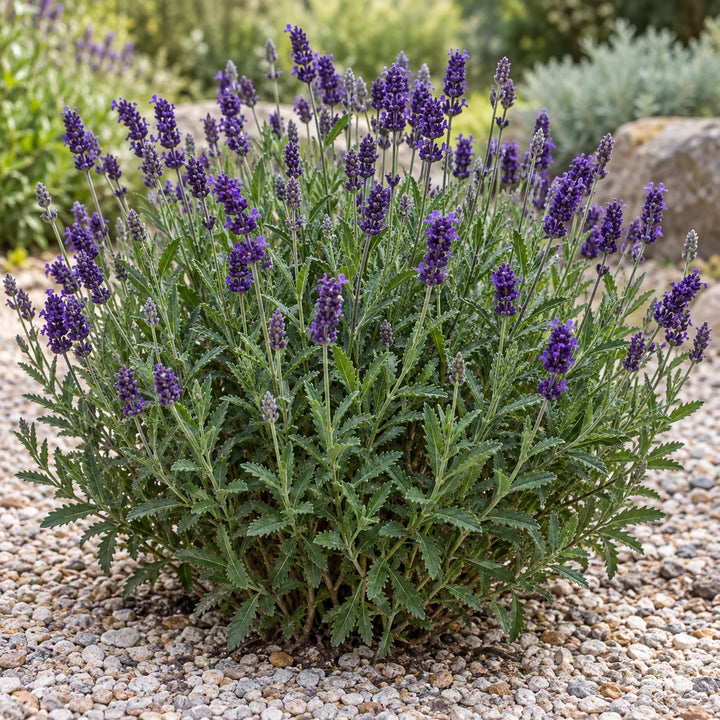
Dolavimpear lavender is a French lavender in a hurry. In documented trials it began flowering about seven weeks after planting and then bloomed continuously through the summer. Its dark violet flowers sit over dark green foliage on an upright plant that branches freely and spreads outward to about 20 inches.
It is a Lavandula dentata, the toothed-leaf lavender, listed under its cultivar code name. Unusually for its group, its fragrance is described as a strong, typical lavender scent.
Dolavimpear at a glance
| Trait | What to expect |
|---|---|
| Botanical name | Lavandula dentata 'Dolavimpear' |
| Flower color | Dark violet |
| Foliage | Dark green |
| Habit | Upright, spreading outward and freely branching |
| Mature size | About 16 inches tall and 20 inches wide |
| Stems | About 8.5 inches |
| Bloom | Everblooming; year-round in warm climates, early and free-flowering |
| Hardiness | USDA zones 7a to 7b |
| Fragrance | Strong, typical lavender scent |
| Culinary use | Not recommended |
What makes it worth growing
Two things stand out. First, speed: it does not need a winter chill and starts flowering quickly, so a spring planting turns into a patio full of color in short order. Second, the look: dark violet flowers against dark green leaves are a richer, moodier combination than the pale blue and silver of many French lavenders.
Its freely branching habit fills a container nicely, and its moderate size, about 16 inches tall, suits mid-sized pots and mixed planters. It is a great pollinator plant, and deer tend to leave it alone.
How cold can it go?
Documented evaluations report tolerance from about 5°F (-15°C) up to about 95°F (35°C), consistent with its zone 7 rating. Michigan winters regularly go colder than that, so plan for winter protection:
- Grow it in a pot with drainage holes and a gritty mix.
- Before hard freezes, move it to a bright, cool, frost-free spot such as a sunroom or cool window.
- Water sparingly over winter, just enough to keep roots from drying out.
- Return it outdoors gradually after frost danger passes. The Frost Date Estimator helps with timing.
Summer care
- Sun: full sun.
- Water: soak, then let the top of the mix dry before the next watering.
- Deadheading: snip spent stems back to the foliage to keep the continuous bloom looking tidy.
- Shaping: a light trim in spring and midsummer keeps it bushy. Avoid bare wood.
- Feeding: light and occasional in containers.
Flowers and uses
Dolavimpear is rated good for both fresh and dried flowers, which is better than many French lavenders. Its listed best use is fragrance. Cut a few stems for a small vase or dry them for sachets, and keep the pot near a doorway where its scent greets you on the way in. Culinary use is not recommended.
Formats offered
Dolavimpear is listed as a 3-inch plug, a 4-inch pot or a 1-gallon pot. See the product page for current sizes and availability, and use Notify Me if it is not ready yet.
Frequently asked questions
How fast does it bloom?
In documented trials it began flowering about seven weeks after planting, then flowered continuously through summer. Timing varies with climate.
Does it smell like French lavender?
Its scent is described as a strong, typical lavender fragrance, rather than the sharper eucalyptus-like note common in its group.
Can it overwinter outdoors in Michigan?
No. It is rated for zone 7, so bring it inside before hard freezes.
















Share how it went in your field