

Use & Care NotesLavender Plants
LaDiva Big Night Lavender: Dark Purple Spanish Blooms All Summer
 Save
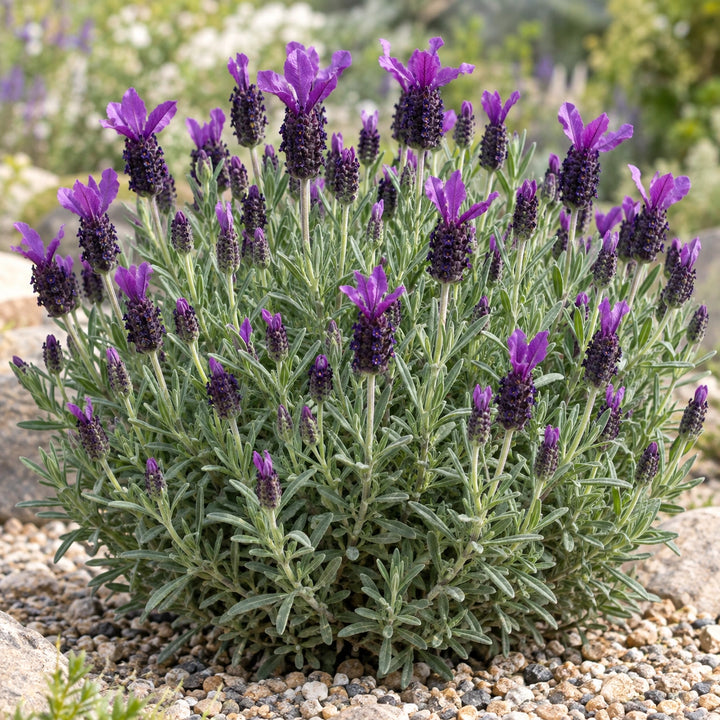
LaDiva Big Night lavender is a Spanish lavender that keeps the party going. Its dark purple flower heads ride on strong stalks above a compact, upright, freely branching mound, and once it starts flowering in early June it blooms continuously through the summer. The flowers carry a strong, typical lavender scent, and the foliage is strongly aromatic and pungent when brushed.
It is a Lavandula stoechas from the La Diva series, also listed under its code name 'Dolavladibini'. It is noted for good performance in both containers and garden beds.
LaDiva Big Night at a glance
| Trait | What to expect |
|---|---|
| Botanical name | Lavandula stoechas LaDiva Big Night (syn. 'Dolavladibini') |
| Flower color | Dark purple, on strong stalks |
| Foliage | Gray-green, strongly aromatic |
| Habit | Compact, upright, uniform and freely branching |
| Mature size | About 14 inches tall and 14 inches wide |
| Bloom | Starts early June, peaks mid-July, continuous |
| Hardiness | USDA zones 6a to 9b |
| Fragrance | Strong, typical lavender scent |
| Culinary use | Not recommended |
A Spanish lavender with a little more backbone
Most Spanish lavenders are rated to zone 7 or 8, which rules them out of many Great Lakes gardens as perennials. LaDiva Big Night is rated to zone 6a. Spanish lavenders as a group are still less cold-hardy than English types, so think of that rating as an opportunity, not a promise: in West Michigan, give it the warmest, best-drained spot you have, such as a raised bed near a south-facing wall, or keep it in a container that can move to shelter during the deepest cold. Check your zone with the USDA Zone Finder.
Where it fits
At about 14 inches tall and wide, it is a natural for:
- Patio pots and porch planters, where continuous bloom keeps things lively all summer
- The front of a hot, sunny border
- Gravel and rock gardens with sharp drainage
- Mixed containers with silver foliage and white or chartreuse partners that set off the dark purple
It is a great pollinator plant, and deer tend to leave it alone.
Planting and care
- Sun: full sun.
- Soil: fast-draining, gritty soil or potting mix. No standing water, ever.
- Spacing: about 14 inches apart in beds.
- Water: soak, then let the top of the soil dry before watering again.
- Deadheading: snip faded heads back to the foliage to keep the continuous bloom looking tidy.
- Shaping: trim lightly after a heavy flush. Avoid bare wood.
- Winter in pots: move containers to an unheated, sheltered spot or a cool, bright room for the coldest weeks.
It does not need a winter chill to bloom, so new plants flower quickly.
Flowers and uses
LaDiva Big Night is rated good for fresh-cut flowers and fair for drying. Its listed best uses are fragrance and u-pick style large bundles, a sign of how many stems it produces over a season. The strong stalks make it easy to cut for a small vase. Culinary use is not recommended.
Formats offered
LaDiva Big Night is listed as a 3-inch plug, a 4-inch pot or a 1-gallon pot. See the product page for current sizes and availability, and use Notify Me if it is not ready yet.
Frequently asked questions
Is LaDiva Big Night the same as Dolavladibini?
Yes. Dolavladibini is the code name for the same plant, sold under the LaDiva Big Night name.
Can it survive a Michigan winter?
It is rated to zone 6a, hardier than most Spanish lavenders. Excellent drainage and a sheltered site give it the best chance.
When does it bloom?
Flowering starts in early June and continues through summer, peaking around mid-July.
















Share how it went in your field