

Use & Care NotesLavender Plants
Dolavladietel Lavender: Low, Spreading Violet-Blue Color All Summer
 Save
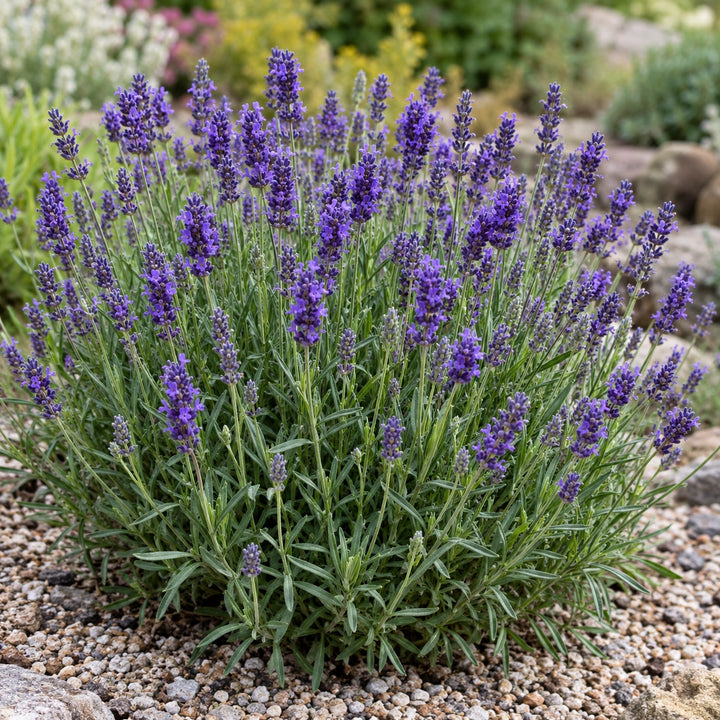
Dolavladietel lavender stays low and spreads wide. It grows only about a foot tall but reaches nearly 19 inches across, a vigorous mound of green foliage covered in violet-blue to dark violet flowers. Its bloom pattern is continuous: it starts in mid-June and keeps going to a peak in early August, with a strong, typical lavender fragrance.
It is a Lavandula angustifolia listed under its cultivar code name. Documented evaluations report tolerance from about -29°F (-34°C) up to about 95°F (35°C), consistent with its zone 5 rating.
Dolavladietel at a glance
| Trait | What to expect |
|---|---|
| Botanical name | Lavandula angustifolia 'Dolavladietel' |
| Flower color | Violet-blue to dark violet |
| Flower spikes | Short, about 1.2 inches |
| Foliage | Green |
| Habit | Low, vigorous, upright to spreading mound |
| Mature size | About 12 inches tall and 19 inches wide |
| Bloom | Continuous; starts mid-June, peaks early August |
| Hardiness | USDA zones 5a to 5b |
| Fragrance | Strong, typical lavender |
A low lavender with a long season
Many low lavenders are short on season as well as height. Dolavladietel is different: its continuous bloom covers roughly June through August, so a front-edge planting stays colorful long after early lavenders have been sheared. In documented trials it began flowering about twelve weeks after planting, so a spring planting usually catches up by midsummer.
Its wide, low shape is ideal for:
- Edging a sunny walk or patio where a taller hedge would block the view
- Spilling over the edge of a raised bed or retaining wall
- Filling the front row of a lavender planting in front of taller cultivars
- Wide, shallow containers
It is a great pollinator plant, and deer tend to leave it alone.
Planting and spacing
Full sun and fast-draining soil are essential. In clay, plant in a raised bed or on a low berm. Because it spreads more than it climbs, space plants about 18 inches apart for a continuous low ribbon. Set the crown level with the soil and keep mulch away from the stems. As an English lavender, it needs a winter chill to bloom well. Use the USDA Zone Finder to confirm your zone.
Care through the year
- Water: deeply during establishment, then sparingly.
- Feeding: little to none.
- Trimming: with continuous bloom there is no single cleanup moment. Snip spent stems as you go, and give a light overall shaping after the August peak.
- Pruning rule: stay in the leafy growth. Bare wood rarely regrows.
- Spring: tidy winter-damaged tips once new growth appears.
The Care Calendar lays out seasonal tasks.
Flowers and uses
Dolavladietel is rated good for fresh and dried flowers, and its listed best use is fragrance. The spikes are short, so it suits tiny posies, sachets and potpourri rather than long bundles. Culinary use is not recommended for this cultivar, so enjoy it as an ornamental and fragrance plant.
Formats offered
Dolavladietel is listed as a 3-inch plug, a 4-inch pot or a 1-gallon pot. For a long edging run, plugs are the economical choice. See the product page for current sizes and availability, and use Notify Me if it is not ready yet.
Frequently asked questions
Is it an English lavender?
Yes. It is listed as Lavandula angustifolia, known by a code-style cultivar name.
Can I cook with it?
Culinary use is not recommended for this cultivar. Choose one with a culinary rating for the kitchen.
How cold can it handle?
Documented evaluations report tolerance down to about -29°F, consistent with its zone 5 rating. Drainage still matters most.
















Share how it went in your field