

Use & Care NotesLavender Plants
Egerton Blue Lavender: A Big English Lavender in Violet and Mauve
 Save
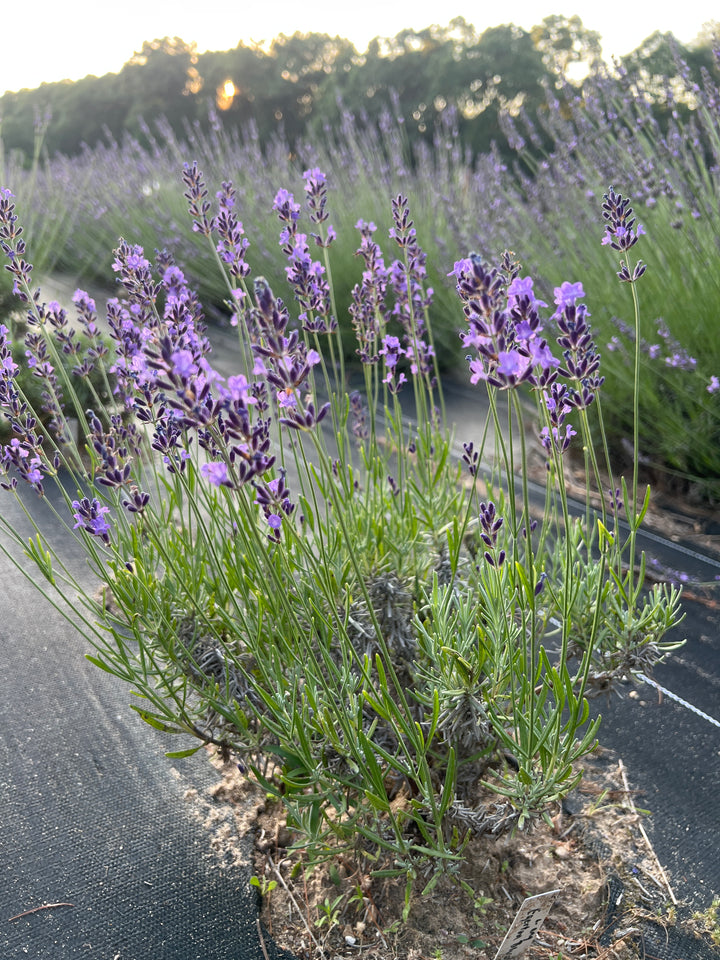
Egerton Blue lavender is an English lavender with lavandin-sized ambitions. It grows into a robust, bushy plant about 3 feet tall and as much as 4 feet wide, with green foliage and flowers that range from dark violet to mauve. The scent is strong and sweet, with soft herbal notes and little camphor, the classic English profile on a much bigger frame.
Botanically it is Lavandula angustifolia 'Egerton Blue', so it brings English lavender's hardiness and culinary quality along with its size.
Egerton Blue at a glance
| Trait | What to expect |
|---|---|
| Botanical name | Lavandula angustifolia 'Egerton Blue' |
| Flower color | Dark violet to mauve |
| Foliage | Green |
| Habit | Robust and bushy |
| Mature size | About 36 inches tall and 48 inches wide |
| Stems | About 12 inches |
| Bloom | Starts late June, peaks mid-July, moderate rebloom |
| Hardiness | USDA zones 5a to 9b |
| Fragrance | Strong, sweet and floral with low camphor |
English lavender on a bigger scale
When gardeners want a big lavender hedge, they usually turn to lavandins. Those are wonderful plants, but their scent and flavor lean sharper and more camphor-forward. Egerton Blue offers another route: the size of a substantial shrub with the sweet, low-camphor character of English lavender. It is rated great for culinary use, which most large lavenders are not.
Its color also has some range. Flowers open dark violet and can show mauve tones, so a mature hedge has a rich, slightly shifting look through July.
Where it fits
- Hedges and screens: plant about 3.5 to 4 feet apart along a sunny fence or property line.
- Back of the border: it provides height and mass behind shorter lavenders and perennials.
- Specimen plant: one plant can anchor a corner or a sunny island bed.
- Kitchen garden boundary: a large, culinary-rated lavender doubles as a fragrant edge and a bud supply.
It is a great pollinator plant, and deer tend to leave it alone.
Planting and care
Full sun and fast-draining soil come first. Because it grows wide, give each plant plenty of airflow; crowded large lavenders stay damp after rain, which invites trouble. In heavy soil, plant on a raised row or berm. As an English lavender, it needs a winter chill to bloom well.
- Water: deeply during establishment, then sparingly.
- Feeding: little to none.
- Shearing: after the July peak, cut back spent stems and some leafy growth to keep the shrub dense and rounded. Large lavenders can open in the center if never trimmed.
- Pruning rule: never cut into bare wood.
The Pruning Calendar and Care Calendar lay out the timing.
Harvest and uses
For culinary buds, harvest in July when buds are colored but before most flowers open. Dry in the shade, rub the buds free and store them airtight. Use only buds from plants grown as a food crop, and start with a small amount. One large plant yields generously.
Egerton Blue is rated good for fresh and dried flowers, with excellent oil suitability. Its 12-inch stems make tidy bundles and sachets.
Formats offered
Egerton Blue is listed as a 3-inch plug, a 4-inch pot or a 1-gallon pot. Since each plant covers a lot of ground, a few plugs go a long way. See the product page for current sizes and availability, and use Notify Me if it is not ready yet.
Frequently asked questions
Is Egerton Blue a lavandin?
No. It is an English lavender, though its size is closer to many lavandins.
How wide does it get?
Up to about 48 inches wide and 36 inches tall, so space plants generously.
Is it good for cooking?
Yes. It is rated great for culinary use, with a sweet, low-camphor profile.
Keep exploring
Ready to plant it?
Sizes, prices and shipping times are on its page.

















Share how it went in your field