

Use & Care NotesLavender Plants
Ellagance Purple Lavender: Early Color from a Compact Plant
 Save
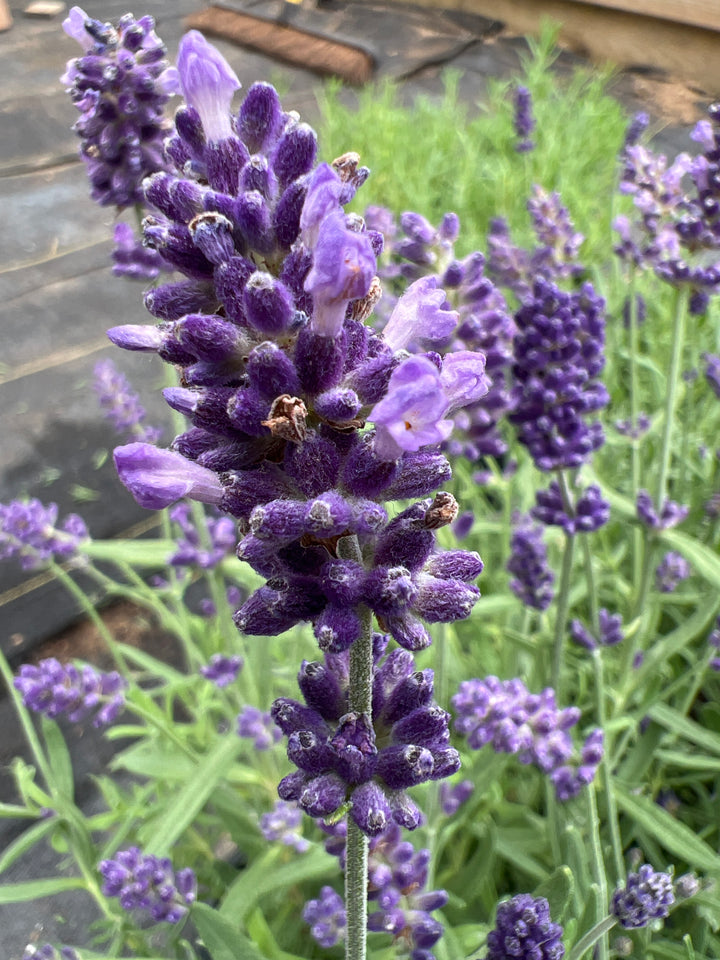
Ellagance Purple lavender is a compact English lavender known for getting started early. Its large, dense purple-blue spikes sit on strong stems over rich gray-green foliage, and the plants tend to be very even in size, which matters when you are planting a row and want it to look like one.
It is also documented as flowering in its first year, so new gardeners do not have to wait a full season to see what they planted.
Ellagance Purple at a glance
| Trait | What to expect |
|---|---|
| Botanical name | Lavandula angustifolia 'Ellagance Purple' |
| Flowers | Large, dense purple-blue spikes on strong stems |
| Foliage | Rich gray-green |
| Mature size | About 12 to 14 inches tall and 10 to 12 inches wide |
| Bloom | Starts early June, peaks mid-July, moderate rebloom |
| Hardiness | USDA zones 5b to 8b |
| Fragrance | Strong, sweet floral lavender with low camphor |
| Wildlife | Great for pollinators; deer resistant |
Why uniformity is a big deal
Some lavenders grown from seed vary from plant to plant: one tall, one squat, one a shade lighter. Ellagance Purple is described as uniform, so a line of them along a path or a matched set of containers comes out looking intentional. Its spreading-upright habit fills in neatly without flopping open in the middle.
The early start is the other selling point. Bloom begins in early June, ahead of many English lavenders, and with deadheading the season stretches long. Pair it with later lavenders and you can keep purple in the garden for weeks; the Bloom Calendar helps you line them up.
Getting it established
Choose the sunniest spot you have and soil that drains within an hour after heavy rain. Space plants about 10 to 12 inches apart for a continuous edge, or a bit wider if you want each mound to stand alone. Water deeply at planting and whenever the top few inches dry out during the first summer.
Note the hardiness range starts at zone 5b. If your garden sits right on the cold edge of zone 5, give it a sheltered, well-drained spot. The USDA Zone Finder will tell you where you stand.
Seasonal care
- Early summer: enjoy the first flush, then shear the spent spikes back to the foliage.
- Midsummer: a second, lighter wave of flowers often follows. Water only in long dry spells.
- Late summer: finish trimming so new growth can firm up before cold weather.
- Spring: shape lightly once green growth appears, staying above the woody base.
Drying, arranging and cooking
Ellagance Purple is noted as well suited for drying and arranging, thanks to its dense spikes and strong stems. Cut when the lowest flowers on each spike have just opened, bundle loosely and hang them in a dark, airy place. The color holds well, and the stems are sturdy enough for small wreaths and posies.
As an English lavender it also rates well for culinary use. Use only buds grown as food, and remember that a little goes a long way in baking.
Sizes offered
Choose from 3-inch plugs, 4-inch pots or 1-gallon pots. Plugs suit long edges and budget plantings; gallons give a fuller first summer. See the product page for current sizes and availability.
Frequently asked questions
Will it really bloom the first year?
It is documented as first-year flowering. Plants that go in by late spring and get plenty of sun usually show color that first summer, though a young plant puts on a lighter show than an established one.
Is it more purple or more blue?
The spikes read as purple-blue: deeper than sky-blue types, cooler than red-purple ones.
How does it compare with Hidcote?
Both are compact English lavenders. Ellagance Purple is smaller and starts earlier; Hidcote is darker and a bit larger. Line them up in the Compare tool.
Keep exploring
Ready to plant it?
Sizes, prices and shipping times are on its page.

















Share how it went in your field