

Use & Care NotesLavender Plants
Ellagance Sky Lavender: A Light Violet-Blue Medal Winner
 Save
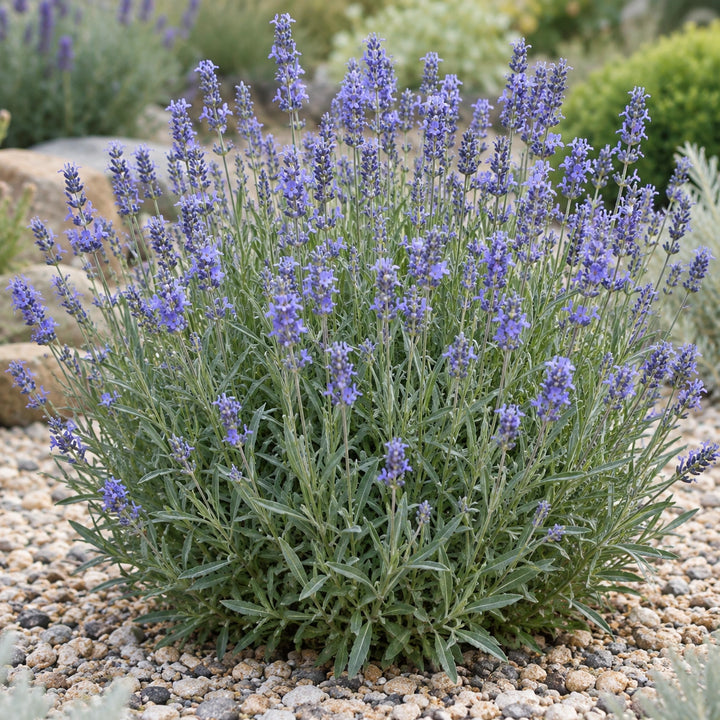
Ellagance Sky lavender brings a cooler color to the English lavender lineup: light violet-blue spikes that look almost silvery in bright sun. It is a compact, seed-raised lavender that branches naturally from the base, so plants fill out into bushy mounds without much coaxing.
In 2006 it won a gold medal in European flower trials, where judges singled out its color, its uniformity, how freely it flowers in the first year and that basal branching.
Ellagance Sky at a glance
| Trait | What to expect |
|---|---|
| Botanical name | Lavandula angustifolia 'Ellagance Sky' |
| Flower color | Light violet-blue |
| Foliage | Gray-green |
| Habit | Bushy, naturally branching from the base |
| Mature size | About 14 inches tall and 12 inches wide |
| Bloom | Starts mid-June, peaks mid-July, moderate rebloom |
| Hardiness | USDA zones 5a to 8b |
| Fragrance | Strong, sweet and floral, low camphor |
Designing with a pale blue lavender
Light blue is the most restful lavender color in a planting. Ellagance Sky looks especially good beside white flowers, silver foliage and soft yellows, and it makes a gentle transition between deep purple lavenders and pink ones. In a pot by the door it reads clean and cool, which is a nice change from the usual purple.
Because it stays small and branches from the base, it is also a good candidate for a low lavender edge or for filling the front row of a mixed bed while taller lavenders stand behind.
Planting and spacing
Plant in full sun in soil that drains fast, adding grit or building a raised bed if you garden on clay. A spacing of about 12 inches gives a continuous band; go to 15 or 18 inches if you want more air between plants in humid summers. Keep the crown at soil level and water in thoroughly.
Check your planting window with the Frost Date Estimator. Getting young plants in early enough lets them root before summer heat and, often, bloom that first season.
Year-round care
- Watering: regular deep watering in the first summer, then only in dry stretches. Low water needs once established.
- Feeding: skip it or go very light. Lean soil keeps the plant compact.
- Trimming: shear spent flowers after the main bloom for a lighter second flush, and shape the mound in spring once growth resumes.
- Winter: as an English lavender it is among the hardier types. Wet soil, not cold, is the real risk.
Harvest and use
English lavender is the go-to type for culinary use, and Ellagance Sky rates well there. Its blue-toned buds look lovely sprinkled on frosted cookies or folded into sugar. Harvest on a dry morning when buds are colored and only a few flowers are open. For dried stems, the same timing keeps the most color, though pale blue lavender dries a little grayer than deep purple.
Plant sizes
Ellagance Sky is offered as 3-inch plugs, 4-inch pots and 1-gallon pots. Plugs are a smart way to plant a long edge; gallons give a finished look sooner. See the product page for current sizes and availability.
Frequently asked questions
Is Ellagance Sky truly blue?
It is a light violet-blue. Next to deep purple lavenders it reads distinctly blue; next to blue flowers like salvia it looks more lavender.
Why does basal branching matter?
Stems that branch from the base make a fuller, rounder plant that is less likely to open up and show bare wood in the center as it ages.
How is it different from the other Ellagance colors?
The series shares a compact size and sweet scent. Sky is the light blue, alongside pink, purple and white options. The Compare tool puts them side by side.
Keep exploring
Ready to plant it?
Sizes, prices and shipping times are on its page.

















Share how it went in your field