

Use & Care NotesLavender Plants
Eola Lavender: Silver Mounds and Rich Violet in Early Summer
 Save
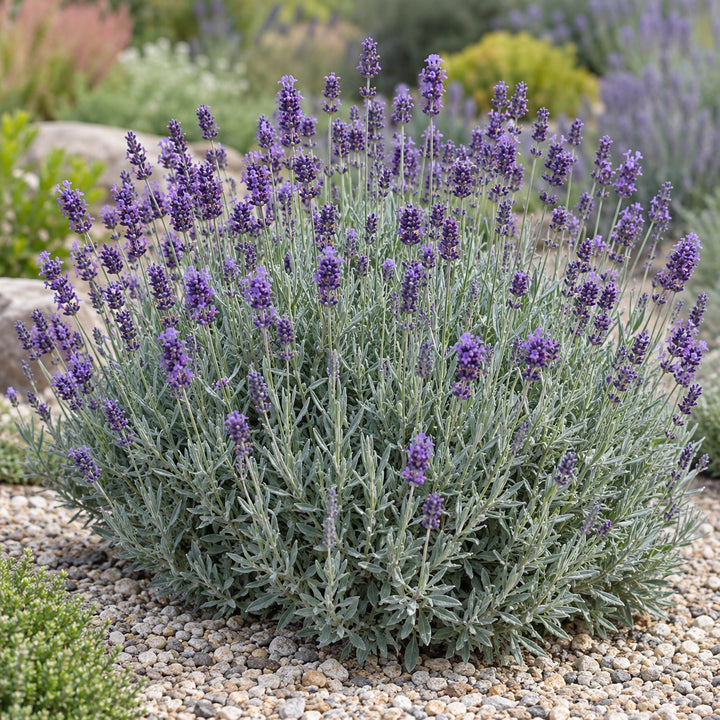
Eola lavender is an English lavender that looks good even when it is not blooming. Its foliage is a bright, blue-tinged silver, and it grows into a rounded, compact mound. In early summer that mound is topped with rich violet flowers on strong 10 to 12 inch stems, carrying a strong, classic lavender scent.
If you have ever wanted the look of a silver garden with a purple flush on top, Eola does most of the work for you.
Eola at a glance
| Trait | What to expect |
|---|---|
| Botanical name | Lavandula angustifolia 'Eola' |
| Flowers | Rich violet-purple |
| Foliage | Bright silver to blue-gray |
| Mature size | About 24 inches tall and 36 inches wide |
| Stems | Strong, about 10 to 12 inches |
| Bloom | Starts early June, peaks mid-June, moderate rebloom |
| Hardiness | USDA zones 5a to 9b |
| Fragrance | Strong classic lavender |
The case for silver foliage
Lavender is in flower for a few weeks and in leaf all year. A cultivar with standout foliage, like Eola, keeps a bed looking finished in spring, after bloom and well into fall. Silver also reflects light, so a row of Eola brightens a dark fence or a stone wall, and it sets off neighbors with deep green or burgundy leaves.
Its early peak is useful too. Eola gets going in June, ahead of many English lavenders and well ahead of the lavandins, so mixing it with later cultivars stretches the purple season. Check the Bloom Calendar to plan the sequence.
Spacing a wide mound
Eola grows wider than it is tall, eventually about 3 feet across. Give each plant roughly that much room, or plant a little closer, about 30 inches, if you want the mounds to touch into a continuous low hedge. Crowded lavender holds humidity and is more prone to problems, so err on the side of space.
Plant in full sun in soil that drains quickly. On heavy ground, build a raised bed or a gentle berm, set the crown at soil level and water deeply at planting.
Through the year
- First summer: water deeply whenever the top few inches dry out.
- After establishment: low water needs; let rain do most of the work.
- After bloom: shear spent stems and shape the mound, staying in the leafy growth. A moderate second flush may follow.
- Winter: Eola benefits from a real winter chill to flower well, so cold winters are a help, not a hurdle. Keep the crown dry and skip heavy mulch.
Cutting and kitchen use
Its 10 to 12 inch stems are a handy length for small bundles, sachets and table posies. Cut when buds are colored and a few flowers are open, then hang to dry. As an English lavender, Eola rates well for culinary use; harvest buds from plants grown as food and use them sparingly.
Plant sizes
Eola is offered as 3-inch plugs, 4-inch pots and 1-gallon pots. Because the mature plant is wide, even plugs fill in quickly once they settle. See the product page for current sizes and availability.
Frequently asked questions
Is Eola good for a low hedge?
Yes. Its rounded, compact habit and wide spread make a tidy low hedge when spaced about 30 inches apart.
Does silver foliage need different care?
No, but silver-leaved lavenders are especially unhappy in wet soil and humid, still air. Sun and drainage keep them bright.
When should I expect the most flowers?
Peak bloom is in mid-June, which is early for an English lavender.
Keep exploring
Ready to plant it?
Sizes, prices and shipping times are on its page.

















Share how it went in your field