

Product Field NotesCompanion Plants
Evening Attire Salvia: Deep Violet-Blue Spikes Next to Lavender
 Save
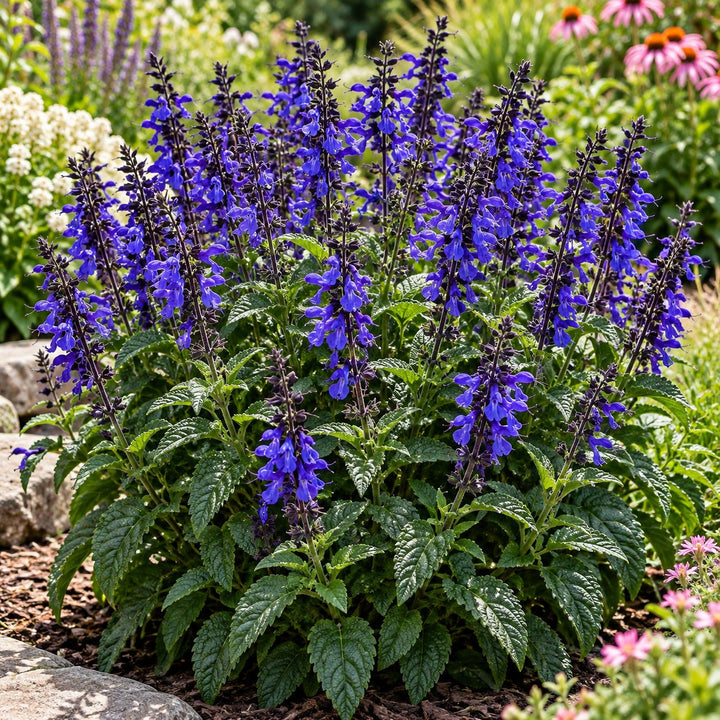
Evening Attire salvia packs its spikes tightly with large, hooded florets in vivid violet-blue, each tucked into a dark purple calyx that adds depth to the color. It is one of the richest blues you can find in a perennial salvia, on a tidy, rounded plant about 20 to 22 inches tall.
For lavender growers, it is a natural partner. It asks for the same full sun, the same lean, well-drained soil and the same light hand with water.
Evening Attire at a glance
| Trait | What to expect |
|---|---|
| Botanical name | Salvia 'Evening Attire' |
| Flowers | Vivid violet-blue with dark purple calyxes |
| Bloom | Starts late May, peaks mid-June, repeats after shearing |
| Size | 20 to 22 inches tall, 24 to 26 inches wide |
| Hardiness | USDA zones 3 to 8 |
| Light | Full sun |
| Wildlife | Excellent for bees and hummingbirds; deer resistant |
| Scent | Flowers unscented; leaves mildly sage-like when brushed |
Why it pairs so well with lavender
Salvia and lavender share an upright, spiky form, so Evening Attire echoes lavender rather than contrasting with it. The real value is timing. It starts blooming in late May, before most lavender opens, and a quick shear after the first flush brings another round later in summer. Planted together, the two stretch the season of purple-blue spikes from late spring well past the lavender harvest.
The deeper, bluer color also gives a lavender bed more range. Try it beside pink or white lavenders for contrast, or with a pale yellow yarrow for a cottage look. Test layouts in the Companion Plant Planner.
Planting and care
- Site: full, hot sun and average, well-drained soil. Wet, heavy soil in winter is the main cause of loss.
- Water: regularly the first season, then it is drought tolerant.
- Feeding: little or none, which keeps stems sturdy.
- Shearing: cut back by about a third once the first spikes fade.
- Air flow: in muggy, crowded plantings the leaves can get powdery mildew after the first flush. Shearing and spacing help.
- Winter: leave stems standing or cut them in fall, then clean up old growth in spring as new leaves appear.
Cutting and pollinators
Evening Attire is a good cut flower and dries fairly well, so a handful of stems can join lavender in a summer bouquet. In the garden, it is a magnet for bees and hummingbirds, making it a strong choice for pollinator plantings. One note for cooks: this is an ornamental salvia, not a culinary sage, so keep it out of the stuffing.
Plug tray or bare root
Evening Attire is offered as a 72-cell plug tray for growers and larger plantings, and as a bare root plant for planting straight into the garden. See each product page for current availability.
Frequently asked questions
Is Evening Attire the same as kitchen sage?
No. It is an ornamental perennial salvia grown for flowers. It is not grown for eating.
Will deer eat it?
Deer tend to leave it alone, which makes it a reliable lavender partner in open, rural gardens.
Does it survive Michigan winters?
Yes, it is reliably hardy in well-drained soil and rated for zones 3 to 8.

































Share how it went in your field