

Product Field NotesCompanion Plants
Firefly Diamond Yarrow: Crisp White Plates Beside Your Lavender
 Save
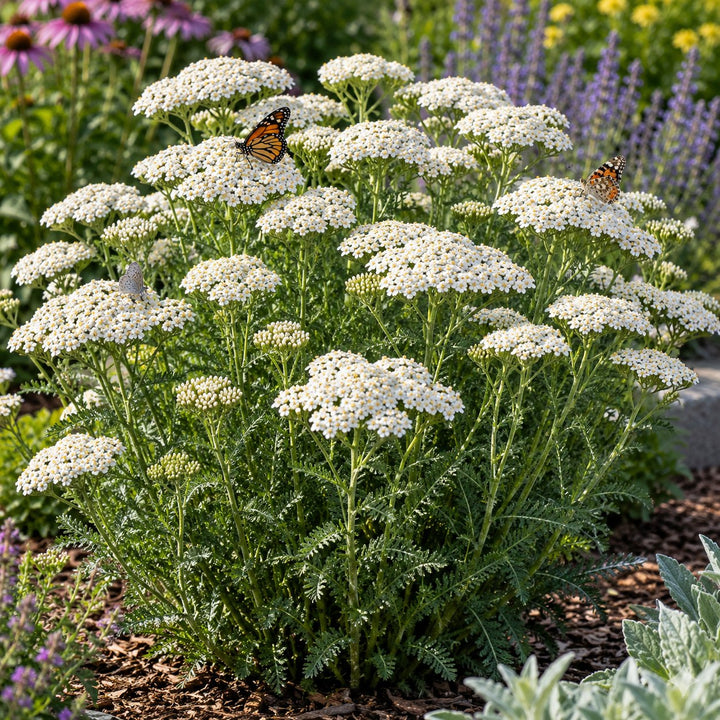
Firefly Diamond yarrow is a bright white yarrow with flat flower heads held high on stiff stems above dark green, feathery leaves. Its blooms stay crisp as they age instead of browning quickly, so the plant keeps looking fresh from early summer well into late summer.
For a lavender planting, it is about as easy a neighbor as you will find. It wants the same sun, the same lean soil and the same restraint with the hose.
Firefly Diamond at a glance
| Trait | What to expect |
|---|---|
| Botanical name | Achillea 'Firefly Diamond' |
| Flowers | Ivory white flat-topped clusters, 3 to 4 inches across |
| Foliage | Dark green, finely divided and fernlike |
| Size | 24 to 28 inches tall, 32 to 40 inches wide |
| Bloom | Starts mid-June, peaks early July, repeat blooms when sheared |
| Hardiness | USDA zones 3 to 8 |
| Light | Full sun |
| Wildlife | Excellent for pollinators; deer resistant |
Why it works with lavender
Lavender gives you vertical purple spikes; Firefly Diamond answers with horizontal white plates. The contrast in shape is what makes the pairing look planned. Both bloom in early to midsummer, so the effect lands at the same time, and both draw bees and butterflies.
Just as important, the two have the same needs. Rich, wet soil makes lavender sulk and makes yarrow tall and floppy. Lean, sunny, well-drained ground keeps both compact and long-lived. Plant the yarrow on the outer edge of a lavender bed or in drifts between groups of lavender, leaving room for air to move around each lavender mound.
Try combinations in the Companion Plant Planner before you order.
Planting and care
- Site: full sun with lean to average, well-drained soil.
- Water: regularly during the first season, then only in long dry spells.
- Feeding: none needed. Extra fertilizer leads to flopping.
- Deadheading: shear the stems back by about half once the first flush fades to encourage more flowers.
- Winter: reliably hardy in Michigan when the soil drains well. Cut spent stems back to the basal leaves in fall or spring; no mulch needed.
In muggy, wet summers lower leaves can brown and mildew can appear in crowded spots, so give it spacing and airflow, the same as you would lavender.
Cutting and drying
Firefly Diamond is a good cut flower and dries well. Cut stems when the clusters are fully open and firm, then hang them upside down in a dry, shaded place. White yarrow and dried lavender make a simple, classic farmhouse bundle.
Plug trays or bare root
This variety is offered as a full 72-cell plug tray, which suits growers and anyone potting up their own plants, and as a bare root plant for direct planting. See each product page for current availability.
Frequently asked questions
Will Firefly Diamond spread?
It forms a strong upright clump that widens over time rather than running wildly. Divide it every few years if it outgrows its space.
Can I eat this yarrow?
No. Firefly Diamond is grown as an ornamental. Its foliage has a sharp herbal scent when brushed, but it is not grown for eating.
Do deer bother it?
Deer and rabbits tend to leave it alone, which makes it a reliable partner for lavender in open, rural gardens.

































Share how it went in your field