

Use & Care NotesCompanion Plants
Godzilla Giant Painted Fern: Silver Fronds on a Grand Scale
 Save
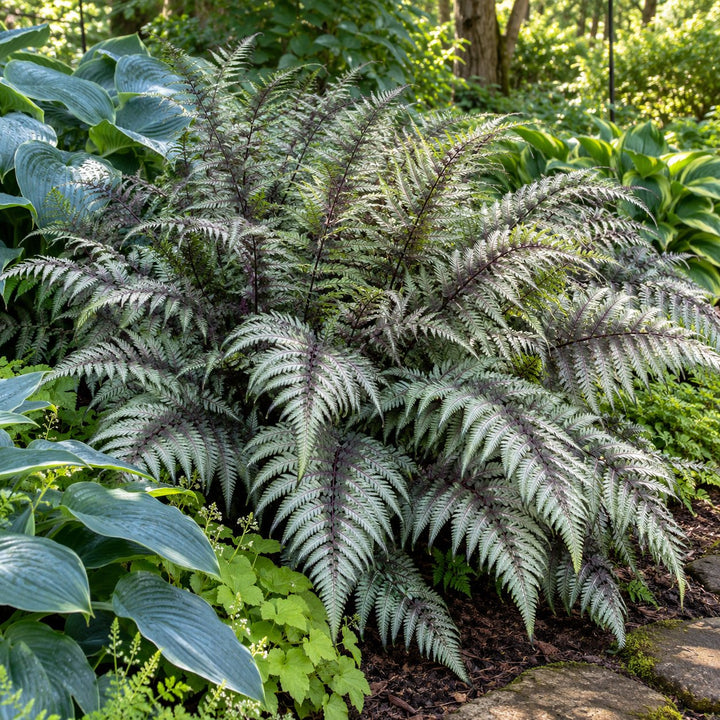
Godzilla giant painted fern takes everything people love about painted ferns, the silver fronds and dark purple stems, and scales it up. Fronds up to about 3 feet long arch outward from a clump that reaches about 3 feet tall and, over time, 4 to 6 feet wide. The leaflets are silvery gray with green shading along the centers, and the purple midribs show clearly through the silver.
The name is fair. It does take over a corner, though far more politely than its namesake.
Godzilla at a glance
| Trait | What to expect |
|---|---|
| Botanical name | Athyrium 'Godzilla' |
| Foliage | Silvery gray with green highlights, dark purple stems |
| Size | About 36 inches tall, 4 to 6 feet wide over time |
| Habit | Large, arching, mounded clump |
| Spread | Slowly, in moist loamy soil |
| Hardiness | USDA zones 3 to 8 |
| Light | Part sun to part shade, full shade |
| Deer | Resistant |
A fern for the big shady spaces
Most painted ferns are small enough to tuck between hostas. Godzilla is big enough to be the main event. It works as a low-maintenance filler for large shady borders, a bold mass planting under mature trees or a soft, cascading edge along a woodland path. It looks especially good beside big hostas and other bold shade plants, where its finely cut silver fronds contrast with their broad leaves.
Lavender is a sun and drainage plant, so the two never share a bed. On a property with both, the silver tones of each can echo across the yard: lavender's gray in the sunny beds, Godzilla's silver in the shade. Lay out both in the Companion Plant Planner.
Planting and care
- Spacing: plan for its mature width. A clump that reaches 6 feet across needs real room.
- Soil: moist, loamy and rich in organic matter, with good drainage.
- Water: water during dry spells. Hot, dry sites scorch the fronds and brown them by late summer.
- Light: afternoon shade is the key protection.
- Problems: few. Crown rot or leaf spot can occur in soggy soil, and slugs may nibble new fronds.
Winter and spring
Godzilla is fully hardy in Michigan and dies back to the ground each winter. Leave the old fronds over the crown as protection, then cut them away in early spring before the new fiddleheads unroll. The plant is sterile, so it will not scatter spores into the rest of the garden; any spread comes slowly from the clump itself.
Two tray sizes
Godzilla is offered as a 72-cell plug tray and a 20-cell plug tray. The 72-cell tray suits large mass plantings; the 20-cell tray's larger cells give each plant a stronger start. See the product pages for current availability, or visit the Wholesale Hub.
Frequently asked questions
Does it grow in containers?
Yes, in a large container with moist, rich mix in the shade. It will stay smaller than in the ground.
How fast does it reach full size?
It grows to height fairly quickly, but the full 4 to 6 foot width comes over several years.





Share how it went in your field