

Use & Care NotesLavender Plants
Jaubert Lavender: An Early, Very Fragrant Lavandin That Goes Wide
 Save
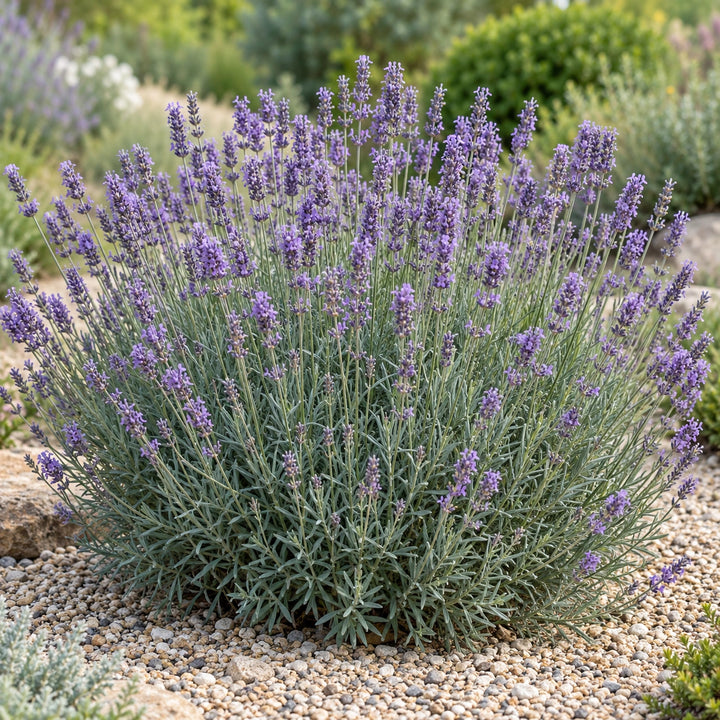
Jaubert lavender is a lavandin built on a generous scale. It grows about 31 inches tall and more than 4 feet wide, with lilac-purple spikes over blue-gray foliage, and both the flowers and the leaves are very aromatic. Its fragrance is rated exceptional.
Botanically it is Lavandula × intermedia 'Jaubert', a hybrid of English and spike lavender rated for USDA zones 5a to 9b. What sets it apart from many lavandins is timing: it starts in early June and peaks in mid-June, so it is in full color while most of its relatives are still budding.
Jaubert at a glance
| Trait | What to expect |
|---|---|
| Botanical name | Lavandula × intermedia 'Jaubert' |
| Flower color | Lilac-purple |
| Foliage | Blue-gray, very aromatic |
| Size | About 31.5 inches tall and 51 inches wide |
| Bloom | Starts early June, peaks mid-June, single main flush |
| Hardiness | USDA zones 5a to 9b |
| Fragrance | Exceptional |
| Ratings | Excellent for oil, cut and dried flowers, pollinators and field rows |
Planning for the width
The most common mistake with Jaubert is underestimating it. At maturity a single plant can cover more than 4 feet of ground, so plant it where it can spread: the back of a wide border, a slope, the corner of a sunny yard or a farm row with generous spacing. Crowding lavandins traps humidity around the stems, and that is when problems start.
For rows, space plants roughly 4 feet apart with wide aisles for harvesting. In a garden bed, one Jaubert can anchor a whole section, with smaller English lavenders in front to extend the season.
Planting and care
- Sun: full sun, the more the better.
- Soil: sandy, gravelly or raised. Heavy clay needs mounding or a raised row.
- Water: deeply through the first season, then low water needs once established.
- Feeding: skip it. Lean soil keeps stems upright.
- Pruning: after harvest, shape into a rounded mound, staying above bare wood.
- Winter: drainage first; heavy wet mulch over the crown does more harm than good.
See the Pruning Calendar for timing after an early harvest.
An early harvest window
Because Jaubert blooms early, it spreads out the harvest season for growers who also have July lavandins and English types. Cut for dried bundles on a dry morning when the first few flowers on each spike are open; the blue-gray stems and lilac color dry nicely. For oil, growers let bloom progress further before cutting. The Harvest Calendar helps plan which varieties come in when.
Its culinary rating is good, but lavandin is stronger and more camphor-forward than English lavender. Use it lightly, or keep it for sachets, bundles and fragrance where its exceptional scent shines.
Plant formats
Jaubert is listed as a 3-inch plug, 4-inch pot and 1-gallon pot. Because it grows so large, even a plug fills out quickly with good care. See the product page for current sizes and availability, or check Availability Alerts if it is not available right now.
Frequently asked questions
Is Jaubert an early lavandin?
Yes. It begins in early June and peaks in mid-June, earlier than many lavandins.
Will it rebloom?
Rebloom is low. Plan on one big flush, then enjoy the blue-gray foliage the rest of the year.
Is it too big for a small garden?
Probably. At over 4 feet wide it suits larger spaces. In a small yard, a compact English lavender is easier to fit.
















Share how it went in your field