

Use & Care NotesLavender Plants
Kew Red Lavender: A Red-Toned Spanish Lavender for Warm Patios
 Save
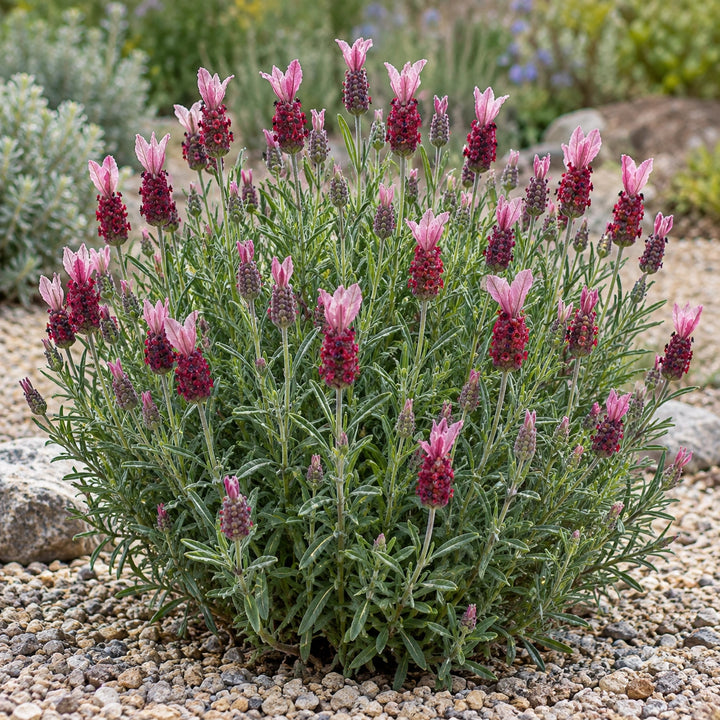
Kew Red lavender is a Spanish lavender known for its red-toned flowers, an unusual color in a plant most people picture as purple. It grows compact and upright, about 24 inches tall and wide, with green foliage and a strong, bold fragrance.
It is Lavandula stoechas, rated for USDA zones 8a to 10b. That makes it a warm-climate lavender; in Michigan it is a container plant to overwinter indoors or a showy annual. It starts early, blooming from early May where it grows outdoors, and it reblooms well.
Kew Red at a glance
| Trait | What to expect |
|---|---|
| Botanical name | Lavandula stoechas 'Kew Red' |
| Flower color | Red-toned |
| Foliage | Green, compact and upright |
| Size | About 24 inches tall and 24 inches wide |
| Bloom | Starts early May, peaks mid-May, high rebloom |
| Hardiness | USDA zones 8a to 10b (annual in Michigan) |
| Water needs | Low once established |
| Fragrance | Strong; bold resinous-herbal with camphor and eucalyptus-like notes |
Growing a lavender that is not purple
Red-toned lavender is a conversation plant. On a patio or front step, Kew Red stands apart from every other pot of lavender in the neighborhood. Warm colors suit it: a terra cotta, cream or deep blue container, a stone wall, weathered cedar. In mixed plantings it pairs nicely with white or pale pink Spanish lavenders, which make the red tones pop.
At about two feet tall and wide, it is larger than many container lavenders, so one plant can fill a 16-inch pot by itself.
Planting and care
- Sun: full sun all day if possible.
- Soil: lean, gritty, fast-draining. A pot with large drainage holes is a must.
- Water: deep watering, then let the top inch dry. Low water needs once settled.
- Deadhead: remove spent heads regularly; its high rebloom depends on it.
- Shaping: after a flush, shear lightly to keep it compact. Avoid bare wood.
- Feeding: very little.
Plant outdoors after the last frost; the Frost Date Estimator will help.
Overwintering in the north
Kew Red will not survive a Michigan winter outdoors. Before the first hard freeze, move the pot into a cool, bright room or unheated sunroom. Water sparingly, skip fertilizer and keep it away from heat vents. In spring, trim back any weak growth and move it out once frost danger is over. A two-foot plant needs a good-sized sunny spot indoors, so plan ahead. If space is tight, a fresh plant each spring may be the simpler route, and it will bloom the same season since Spanish lavender needs no winter chill to flower.
Cutting and uses
Its cut flower rating is good; the flags lose shape when dried, so its dried rating is fair. Growers like it for large, colorful bundles of fresh stems. Its strong resinous scent makes a cheerful fresh bouquet. It is ornamental, not culinary.
Plant formats
Kew Red is listed as a 3-inch plug, 4-inch pot and 1-gallon pot. See the product page for current sizes and availability.
Frequently asked questions
Is Kew Red truly red?
Its flowers are red-toned, unusual for lavender. Color can look more purple-red or more pink-red depending on light.
Can I keep it in the garden all year?
Only in zones 8a to 10b. Elsewhere, overwinter it indoors or plant it as an annual.
Do deer eat it?
It is rated deer resistant, and pollinators visit it heavily.
















Share how it went in your field