

Use & Care NotesLavender Plants
LABZ0004 Spanish Lavender: Deep Purple Flags for Spring Containers
 Save
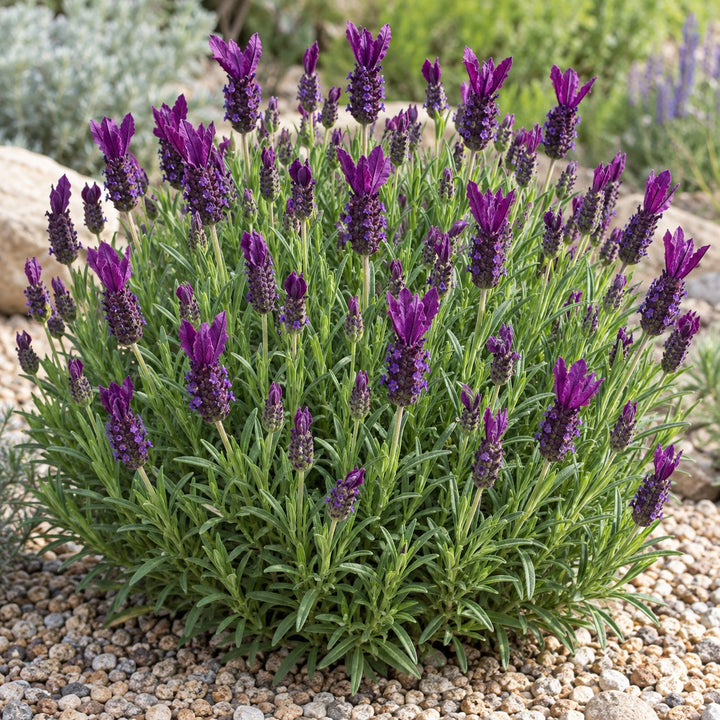
LABZ0004 lavender is a Spanish lavender, the kind with fat flower heads topped by little upright petals that look like rabbit ears or flags. In this selection those top bracts are a deep purple over purple flowers, on a rounded, mounding plant about 14 inches tall. It starts blooming early and keeps going.
For Great Lakes gardeners, it is a warm-climate lavender. Its hardiness rating is USDA zones 8b to 9a, so in Michigan it is a container plant or a long-blooming annual, not a perennial for the open garden.
LABZ0004 at a glance
| Trait | What to expect |
|---|---|
| Botanical name | Lavandula stoechas LABZ0004 |
| Bracts and flowers | Deep purple sterile bracts over purple flowers |
| Foliage | Medium green |
| Size | About 14 inches tall and 13 inches wide |
| Bloom | Starts early May, peaks late May, high rebloom |
| Hardiness | USDA zones 8b to 9a |
| Fragrance | Moderate; resinous, camphor and eucalyptus-like |
| Best uses | Pollinators, fragrance, dried flowers, fresh bouquets |
How Spanish lavender differs from English
English lavender needs a cold winter to bloom; Spanish lavender does not. That is exactly why LABZ0004 is so useful in a cold climate. It will flower in its first season in a pot, starting early in the year, and with a high rebloom rating it keeps producing new heads as long as you remove the old ones.
The scent is different too. Instead of sweet and floral, Spanish lavender is bold and resinous, with camphor and eucalyptus-like notes. Many people enjoy it as a fresh, herbal smell on a sunny patio. It is not a kitchen lavender; culinary use is not recommended.
Growing it in Michigan
- Containers: a 10 to 12 inch pot with drainage holes and a gritty, fast-draining mix is ideal.
- In the ground: plant after your last frost in the sunniest, best-drained spot you have and enjoy it as an annual.
- Watering: let the top inch or two of mix dry between waterings. Pots dry faster in July, so check often then.
- Deadheading: snip each head off at the first set of leaves once its bracts fade.
- Overwintering: bring it in before hard frost to a bright, cool window or unheated sunroom and water sparingly until spring.
The Frost Date Estimator helps you time both moving it out and bringing it in.
Design ideas
Those deep purple flags are made for being seen up close. Use LABZ0004 as the center of a mixed container with trailing silver foliage, or line a few pots up a set of sunny steps. It is great for pollinators, so a pot near a vegetable garden earns its keep. Its compact, rounded shape also suits window boxes in full sun.
For cut flowers, pick heads when the bracts are colored but fresh. They last well in a small vase and dry well if hung in a dark, airy spot, keeping much of their shape.
Sizes offered
Choose a 3-inch plug, a 4-inch pot or a 1-gallon pot. A gallon makes an instant patio feature; plugs are good for filling several containers. See the product page for current sizes and availability.
Frequently asked questions
Will LABZ0004 survive winter outside in Michigan?
No. It is rated for zones 8b to 9a. Grow it as an annual or overwinter it indoors in a bright, cool spot.
Why are the top petals called bracts?
They are modified leaves rather than true flowers. They are sterile and showy, while the small true flowers sit in the head below.
Can I plant it next to English lavender?
Yes, they like the same sun and drainage. Just remember the Spanish plant will need to come indoors or be replaced each year, so a pot set among the hardy plants is often the easiest approach.
















Share how it went in your field