

Product Field NotesLavender Plants
Fern Leaf Lavender: Feathery Foliage and Flowers Until Frost
 Save
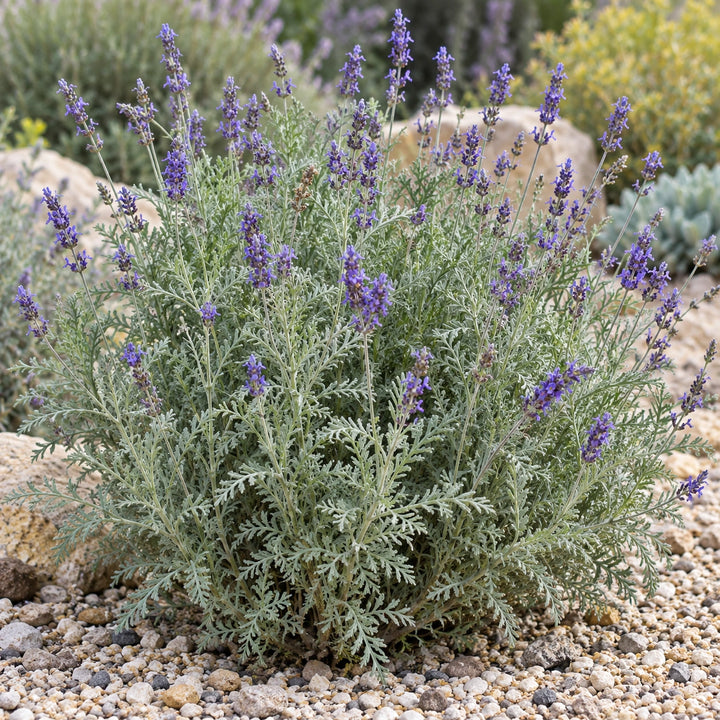
Fern leaf lavender is Lavandula multifida, and its leaves really do look like a small fern: soft, finely cut and feathery. Above them, slender violet-blue spikes appear in an everblooming pattern, so a healthy plant flowers continuously from the time it settles in until frost. It grows to roughly 24 inches tall and wide.
Its scent is unlike most lavenders: pungent and herbal, resinous and camphor-like, sometimes with spicy notes from carvacrol, an aroma compound also found in oregano.
Fern leaf lavender at a glance
| Trait | What to expect |
|---|---|
| Botanical name | Lavandula multifida |
| Group | Pterostoechas |
| Flower color | Violet-blue |
| Foliage | Finely dissected, fern-like |
| Size | About 24 inches tall and 24 inches wide |
| Bloom | Everblooming; year-round in warm climates, peak mid-July |
| Fragrance | Moderate; pungent herbal, resinous, sometimes spicy |
| Identity | Commercial species stock; traits can vary |
Why gardeners love it as an annual
Fern leaf lavender is one of the most generous lavenders for a cold-climate summer. It does not need a winter chill to bloom, it grows quickly and it flowers continuously. Set out a plant after the last frost and it will carry spikes all season, which makes it a natural for mixed containers, window boxes and the sunny edge of a vegetable garden where bees are welcome. It is rated great for pollinators.
The feathery texture is also a handy design tool. It softens bold leaves like coleus or sweet potato vine in a container and fills gaps between heat-loving annuals.
Planting and care
- Sun: full sun. Shade makes it lanky and shy to flower.
- Soil: fast draining. In beds, add grit; in pots, use a gritty mix.
- Water: water deeply, then let the top dry. It handles dry spells better than soggy roots.
- Feeding: light. A little slow-release fertilizer in a pot supports its nonstop bloom.
- Deadheading: trim spent spikes back to a leaf pair every week or two.
Winter options
The listing does not give a hardiness range, and Pterostoechas lavenders are frost-tender. You can let it finish with the first frost and replant next year, or bring a potted plant indoors to a cool, bright window. Indoors, water sparingly; in strong light it may keep flowering lightly. Return it outdoors after your last frost, using the Frost Date Estimator for timing.
Cutting and drying
Fern leaf lavender is rated good for fresh and dried flowers. Its slim spikes and lacy leaves bring a delicate line to small arrangements. Cut in the morning and get stems into water quickly. Dried sprigs keep their shape well for crafts. Because the scent is pungent and spicy rather than sweet, use it where a fresh herbal note suits. Culinary use is not recommended.
It is offered as a 3-inch plug, a 4-inch pot or a 1-gallon pot. See the product page for current sizes and availability.
Its quick growth also makes it a good choice for filling gaps in a new bed while slower perennials settle in.
Frequently asked questions
Why does my fern leaf lavender smell like herbs instead of lavender?
Its fragrance is naturally pungent and resinous, sometimes spicy, quite different from sweet English lavender.
Will it bloom the first year?
Yes. It is everblooming and does not need a cold winter to flower.
Can it stay outside in Michigan?
No. It is frost-tender. Grow it as an annual or overwinter it indoors.

































Share how it went in your field