

Use & Care NotesCompanion Plants
Lavender Lightsaber Speedwell: A Narrow Pillar of Soft Lavender
 Save
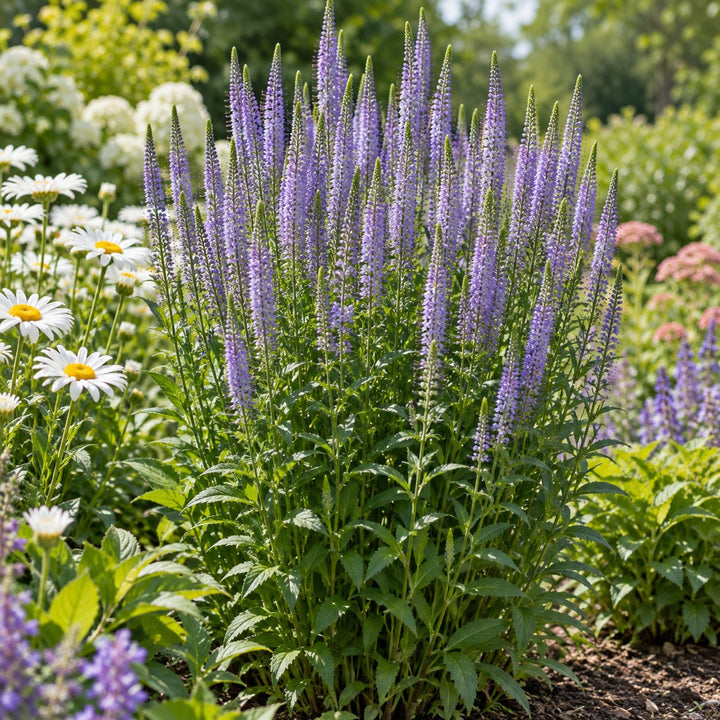
Lavender Lightsaber spike speedwell is a narrow, columnar plant crowned with slender, tapering spikes of tiny soft lavender florets. The spikes cover the top half of the plant, rising on stiff, upright stems over pairs of finely toothed green leaves. It grows 28 to 30 inches tall but only 18 to 20 inches wide, which is exactly what makes it useful.
No force required to grow it, just sun and a little water. Bees are frequent visitors, and deer tend to leave it alone.
Lavender Lightsaber at a glance
| Trait | What to expect |
|---|---|
| Botanical name | Veronica 'Lavender Lightsaber' |
| Flowers | Soft lavender, on slender spikes several inches long |
| Foliage | Green, lance-shaped, finely toothed |
| Size | 28 to 30 inches tall, 18 to 20 inches wide |
| Bloom | Starts mid-June, peaks mid-July, long blooming |
| Hardiness | USDA zones 4-8 |
| Light | Full sun to part shade |
| Wildlife | Excellent for bees and butterflies; deer resistant |
Height for narrow spaces
Many tall perennials get wide as they get tall. Lavender Lightsaber stays a slim pillar, so it adds height to narrow beds, small gardens and the middle of a border without crowding its neighbors. Next to lavender, its soft lavender spikes look like a taller, slimmer cousin, blooming from mid-June through July right alongside the lavender harvest.
Its spikes also make a nice contrast with round, daisy-type flowers like coneflowers, so a bed of lavender, speedwell and coneflower covers three shapes in one color story. The one adjustment: speedwell wants a little more moisture than lavender, so plant it on the outer edge where it can get occasional water. Lay it out in the Companion Plant Planner.
Planting and care
- Site: full sun to part shade, average and well-drained soil that does not stay dry for long.
- Water: steady moisture in hot spells keeps it blooming and the lower leaves green.
- Deadheading: cut each spent spike back to the next set of side buds.
- Airflow: space plants so air moves freely, which helps limit mildew in humid summers.
- Winter: cut back spent stems in fall or early spring. Well-drained soil prevents winter crown rot.
- Dividing: divide crowded clumps every few years in spring.
For the vase
Lavender Lightsaber is a good cut flower. Cut spikes when the lower florets are open and the tips are still in bud. Mixed with fresh lavender, it adds length and a softer texture to the bunch. The Cut Flower Planner helps you plan a cutting row.
Plug tray or bare root
Lavender Lightsaber is offered as a 72-cell plug tray for growers and mass plantings, and as a bare root plant for home borders. See each product page for current availability.
Frequently asked questions
Is it related to lavender?
No. It is a speedwell, Veronica, named for its soft lavender color. It just happens to look at home beside the real thing.
Does it need staking?
Rarely. Its stems are stiff and upright, and its narrow habit keeps it standing.
















Share how it went in your field