

Product Field NotesCompanion Plants
Lavender Sapphires Penstemon: Two-Tone Tubes for Hummingbirds
 Save
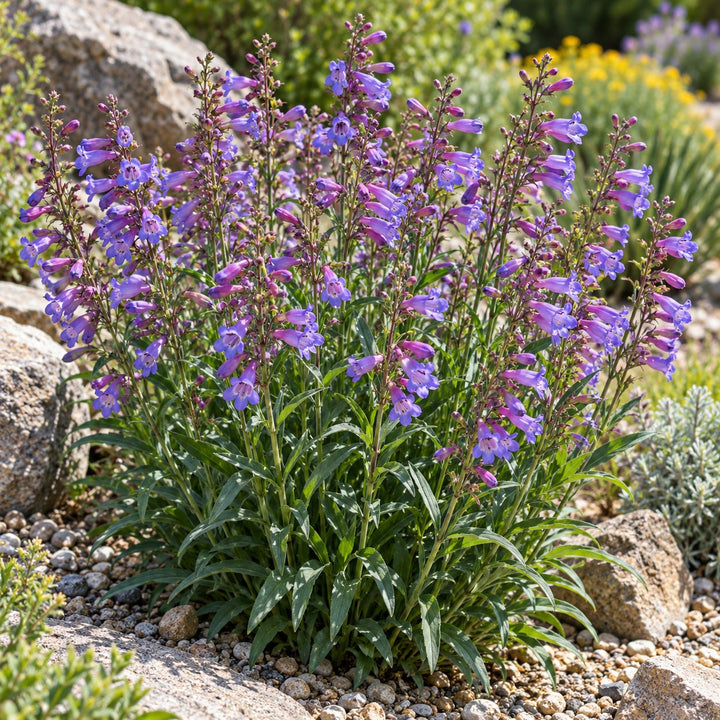
Lavender Sapphires penstemon is a bearded penstemon, or beardtongue, with narrow tubular flowers about an inch long that are rosy purple at the base and shade to soft blue-violet at the flared tips. They line the upper half of slender, upright stems over a dense clump of smooth, dark blue-green leaves, about 16 to 18 inches tall and 20 to 24 inches wide.
It comes from a series bred for compact, sturdy, long-lived plants that attract hummingbirds, and it handles heat, humidity and cold winters well.
Lavender Sapphires at a glance
| Trait | What to expect |
|---|---|
| Botanical name | Penstemon barbatus 'Lavender Sapphires' |
| Flowers | Tubular, rosy purple shading to blue-violet tips |
| Foliage | Dark blue-green, lance-shaped, in a dense basal clump |
| Size | 16 to 18 inches tall, 20 to 24 inches wide |
| Bloom | Early June for about four weeks, peaking mid-June |
| Hardiness | USDA zones 4-8 |
| Light | Full sun |
| Wildlife | Great for hummingbirds and bees; moderately deer resistant |
A matched planting with lavender
Lavender Sapphires blooms alongside the first lavender flowers in June, and its purple-to-blue tubes sit squarely in lavender's color range. The result is a planting that looks unified but not repetitive, because the flower shapes differ: lavender's tight spikes beside penstemon's open, bell-like tubes. Hummingbirds go for the penstemon and bees work both.
The care match is just as close. Penstemon needs the same full sun and sharp drainage as lavender, and it dislikes wet, heavy soil in winter for the same reasons. At under 18 inches, it fits the front row or the gaps between lavender plants. Try layouts in the Companion Plant Planner.
Planting and care
- Site: full sun with sharp drainage. Gravelly or sandy soil and gentle slopes are ideal.
- Water: regular water during its first season, then it handles dry spells.
- After bloom: cut flower stalks down to the leafy base. This tidies the plant and can bring a smaller repeat bloom in late summer.
- Humidity: humid weather plus wet soil leads to crown rot, so keep air moving and drainage sharp.
- Winter: leave the basal leaves in place over winter, and do not pile mulch over the crown.
- Pests: few problems beyond the occasional aphid or spider mite.
Rock gardens and containers
Beyond the lavender bed, Lavender Sapphires suits rock gardens, naturalized sunny areas and well-drained containers. Its blue-green foliage stays handsome all season, so it earns its spot even after the flowers finish.
The 72-cell plug tray
Lavender Sapphires is offered as a 72-cell plug tray, a practical way to plant a front-row edging along a lavender border or a hummingbird garden. See the product page for current availability, or visit the Wholesale Hub.
Frequently asked questions
Why is it called beardtongue?
Many penstemons have a small fuzzy, beard-like stamen in the throat of each flower, which gives the group its common name.
Why did my penstemon die over winter?
Wet winter soil is the main cause of loss. Choose a sharply drained spot and skip heavy mulch.

































Share how it went in your field