

Product Field NotesCompanion Plants
Lavender Taffeta Bee Balm: Lilac Heads Next Door to Lavender
 Save
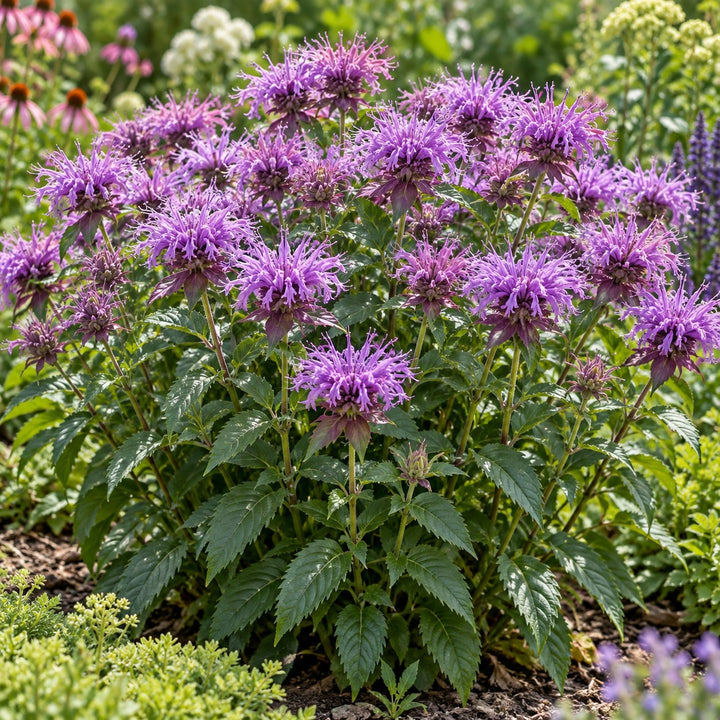
Lavender Taffeta bee balm is a substantial, rounded plant about 2 feet tall and a little wider, with shaggy heads of dark lilac-purple flowers sitting on purple-tinted bracts. After the first round of bloom, side branches push out a second tier of heads just below the first, stretching the show from midsummer into late summer.
It was bred for good powdery mildew resistance, the classic weak spot of bee balm, and its shiny dark leaves release a strong minty, oregano-like scent when brushed.
Lavender Taffeta at a glance
| Trait | What to expect |
|---|---|
| Botanical name | Monarda 'Lavender Taffeta' |
| Flowers | Dark lilac-purple heads on burgundy-tinted bracts |
| Foliage | Shiny dark green, strongly aromatic |
| Size | 22 to 26 inches tall, 28 to 30 inches wide |
| Bloom | Early July into late summer, peaking late July, with repeat flush |
| Hardiness | USDA zones 4-8 |
| Light | Full sun to part shade |
| Wildlife | Excellent for bees, butterflies and hummingbirds; deer resistant |
A good neighbor, not a bedmate
Bee balm and lavender share sun and pollinators, but not soil. Bee balm wants richer, evenly moist ground and regular water in dry spells; lavender wants lean soil and dry roots. So give Lavender Taffeta a neighboring bed or the far side of a path, with better soil and a hose within reach. From there its lilac-purple heads carry the lavender color on through late summer, and the bee traffic simply moves back and forth.
Its size makes it good for filling the middle of a border or for larger plantings. Map both beds in the Companion Plant Planner.
Planting and care
- Soil: average to fertile, with regular water, especially in summer dry spells.
- Mildew: drought stress makes mildew worse. Steady water and room for air around the stems keep leaves clean.
- Deadheading: remove faded heads to encourage the repeat flush.
- Spreading: it spreads by shallow rhizomes. Divide every two to three years to keep the center vigorous.
- Winter: very winter hardy in Michigan. Cut stems back in fall or leave them until spring.
In the kitchen and the vase
Like other bee balms, its leaves and flowers are edible and are used for herbal tea or as a garnish. Use only plants grown without garden chemicals, and start with a small amount, since the flavor is strong. The flowers are also good for cutting; pick heads when they are freshly open.
Two tray sizes
Lavender Taffeta is offered as a 72-cell plug tray for growers and large plantings, and as a 20-cell plug tray with larger plugs for planting a border. See each product page for current availability, or visit the Wholesale Hub.
Frequently asked questions
Will it take over?
It spreads steadily by shallow rhizomes but is easy to pull or divide. Dividing every few years keeps it in bounds.
Do hummingbirds visit?
Yes. Bee balm's tubular flowers are a hummingbird favorite, along with bees and butterflies.

































Share how it went in your field