

Product Field NotesLavender Plants
Lavenite Petite Lavender: Big Fragrance in a Bushy Clump
 Save
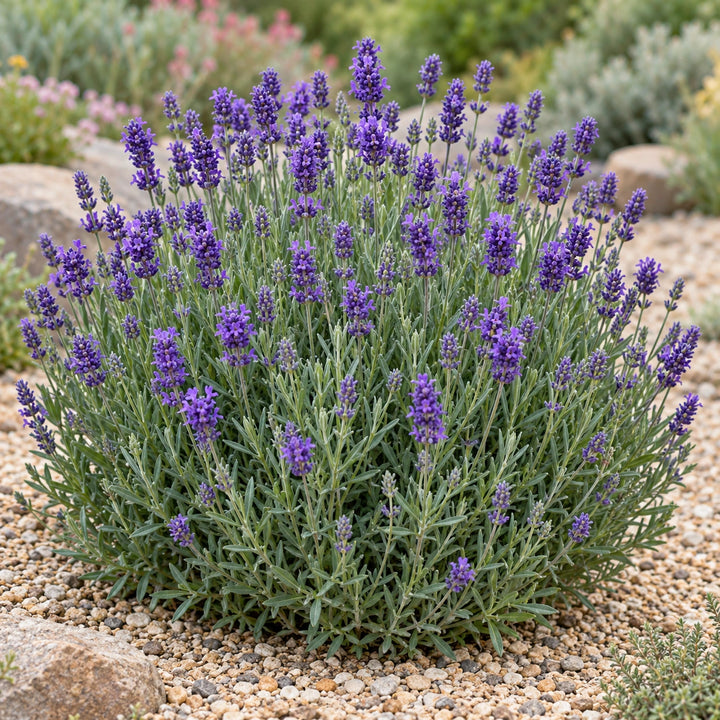
Lavenite Petite lavender is an English lavender introduced in 1989, with violet to violet-blue flowers over gray-green foliage and a fragrance rated exceptional. Its documentation simply calls it very aromatic, which undersells it a little. It grows into a compact, upright, bushy clump about 18 inches tall and 22 inches wide.
Do not let the word petite fool you into planting it in a teacup. It is compact for a lavender, not tiny, and it is rated for a broad span of USDA zones 5a to 10b.
Lavenite Petite at a glance
| Trait | What to expect |
|---|---|
| Botanical name | Lavandula angustifolia 'Lavenite Petite' |
| Flower color | Violet to violet-blue |
| Foliage | Gray-green |
| Size | About 18 inches tall and 22 inches wide |
| Stems | About 8 inches |
| Bloom | Starts mid-June, peaks mid-July, moderate rebloom |
| Hardiness | USDA zones 5a to 10b (RHS H5) |
| Ratings | Great culinary, excellent oil suitability |
Why choose Lavenite Petite
This cultivar combines three things that are hard to find together: strong fragrance, a compact clump and kitchen-worthy flavor. Its culinary rating is great, and English lavender is the traditional choice for cooking because its flavor is sweeter and softer than lavandin. Its essential oil suitability is rated excellent, so it also appeals to small growers exploring oil.
In the garden, the bushy, clump-forming habit makes a tidy low hedge or a strong accent in a sunny border. The gray-green foliage looks good even out of bloom.
Planting and spacing
Full sun and fast drainage are the essentials. Sandy or gravelly soil is ideal; heavy clay needs a raised bed or a mound with added grit. Space plants about 20 to 24 inches apart so mature clumps just touch and air moves between them. Set the crown level with the soil and water deeply at planting. The USDA Zone Finder will confirm your zone.
Care through the year
- Spring: once new growth appears, trim any winter-damaged tips back to green.
- First summer: water deeply when the top few inches are dry; much less once established.
- After bloom: shear spent stems and shape the clump, staying in leafy growth, to encourage a moderate rebloom.
- Fall and winter: no feeding, little water. It needs winter cold to bloom well next year.
Harvest for kitchen and crafts
For culinary buds, cut on a dry morning when the buds are fully colored and only a few flowers have opened. Hang small bundles upside down in a dark, airy place, then rub the buds off. Use only plants grown and handled as a food crop, and start with a small amount; lavender flavor builds quickly. For sachets and bundles, the 8 inch stems are a comfortable length. The Harvest Calendar helps with timing.
Lavenite Petite is offered as a 3-inch plug, a 4-inch pot or a 1-gallon pot. See the product page for current sizes and availability.
Frequently asked questions
Is Lavenite Petite really petite?
It is compact for an English lavender at about 18 inches tall and 22 inches wide, but it is not a miniature.
Is it good for cooking?
Yes. Its culinary rating is great. Use food-grown buds and small amounts.
Will it survive a Michigan winter?
It is rated for zones 5a to 10b and is generally among the hardier lavenders. Sharp drainage is what makes the difference in cold, wet winters.

































Share how it went in your field