

Product Field NotesCompanion Plants
Lion King Japanese Iris: Dinner-Plate Blooms for Wet Ground
 Save
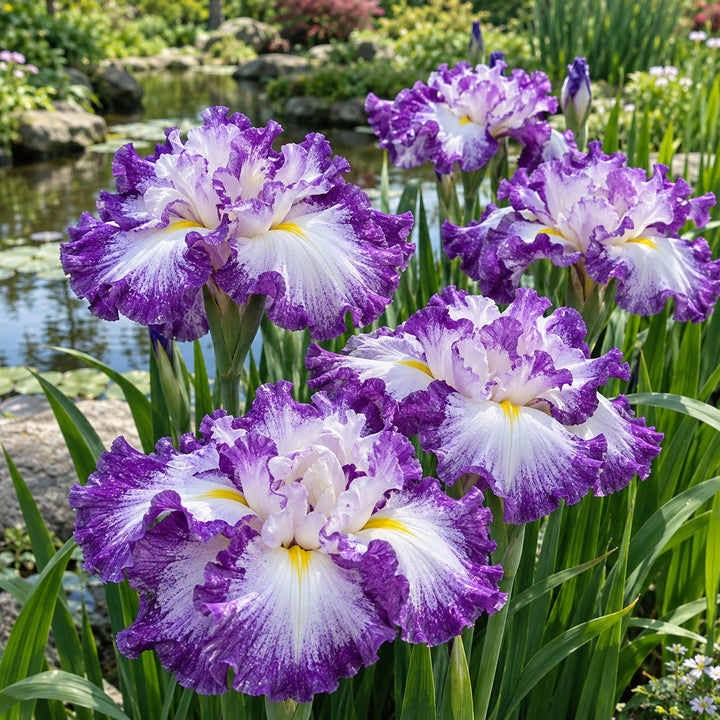
Lion King Japanese iris puts on one of the biggest flower shows in the iris world. Its fully double blooms reach 7 to 8 inches across, with broad, ruffled petals laid out flat, each white in the center with a wide grape-purple border that feathers inward along the veins and a small sunny yellow signal at the base. Held on stems 3 to 4 feet tall, they look like dinner plates floating above the leaves.
It has also earned top honors among Japanese irises, so it is a proven performer as well as a showstopper.
Lion King at a glance
| Trait | What to expect |
|---|---|
| Botanical name | Iris ensata 'Lion King' |
| Flowers | Fully double, 7 to 8 inches, grape-purple edges feathering into white |
| Foliage | Narrow, sword-shaped, mid-green |
| Size | 36 to 48 inches tall, 24 to 28 inches wide |
| Bloom | Mid to late June, about a month after Siberian irises |
| Hardiness | USDA zones 4 to 9 |
| Light | Full sun to part shade |
| Deer | Resistant |
A companion for the wet side of the property
Lavender and Japanese iris share almost nothing in the soil department. Lavender wants dry, lean, fast-draining ground; Lion King wants it rich and moist from spring through bloom. That is exactly why it is useful in a lavender lover's yard. Almost every property has a low spot, a downspout outlet or a pond edge where lavender keeps failing. Put Lion King there instead.
The color link still works across the yard: its grape-purple and white flowers open in late June, when English lavender is in full color, so the two areas bloom together in matching tones. The Companion Plant Planner helps you sort which plants go in which zone of the garden.
Planting the bare root rhizome
- Soil: rich, acidic to neutral and consistently moist. Avoid lime; Japanese irises decline in alkaline soil.
- Water: keep it steadily moist, especially from spring through bloom. In dry sites leaf tips brown and flowers are short-lived.
- Ponds: they do well at pond edges, but crowns should not sit in standing water over winter.
- First winter: mulch new plantings to prevent frost heaving.
Care through the year
After flowering, cut the spent stems. In late fall, clear dead foliage, which removes iris borer eggs, one of the main pests. Every three to four years, divide the clump in late summer to keep it vigorous and blooming well. Leaf spot can show up in long wet spells, so give the clump some airflow.
Cutting the blooms
Lion King is rated good for cut flowers. Cut stems as the first bud starts to open and the rest will follow in the vase. A single stem in a tall vase is plenty; these flowers do not need help making a statement.
Frequently asked questions
Can I plant Lion King in my lavender bed?
No. The dry soil lavender needs would leave the iris thirsty, and the water the iris needs would rot the lavender. Give each its own spot.
Does it have a fragrance?
No notable fragrance. Its draw is the sheer size and color of the flowers.
How is it sold?
As a bare root plant, ready to set in moist ground. See the product page for current availability.

































Share how it went in your field