

Product Field NotesCompanion Plants
Lily of the Valley: Sweet Spring Bells for Shady Corners
 Save
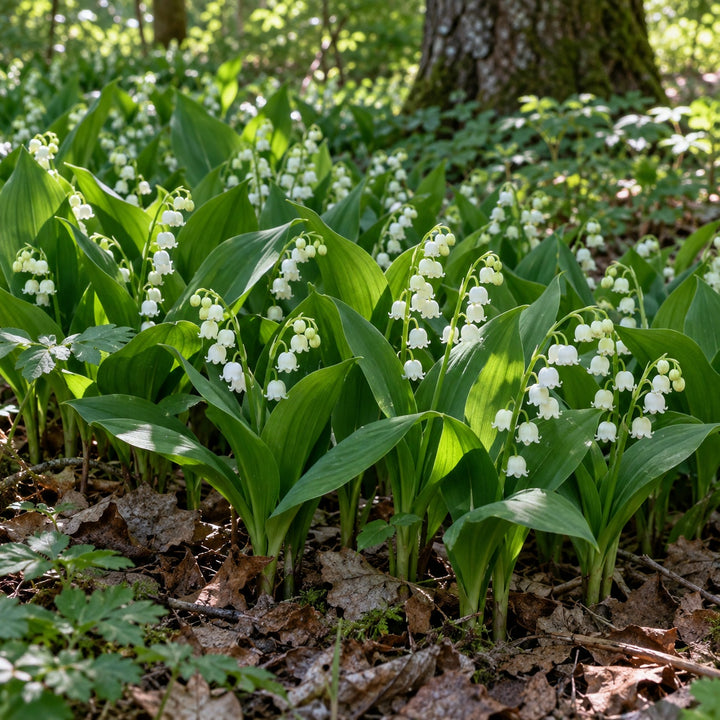
Lily of the valley is an old-fashioned favorite for a reason. In early to mid May, arching stems carry five to eight tiny, waxy white bells with scalloped rims, and their sweet fragrance is one of the classic scents of spring. A handful picked for a small glass can perfume a whole room.
It is tougher than it looks, spreading into a dense groundcover 6 to 8 inches tall in shade where many plants struggle.
Lily of the valley at a glance
| Trait | What to expect |
|---|---|
| Botanical name | Convallaria majalis |
| Flowers | Small, nodding, waxy white bells |
| Foliage | Two or three broad, upright leaves per plant, medium to dark green |
| Size | 6 to 8 inches tall, each clump 12 to 18 inches wide |
| Bloom | Early to mid May for several weeks |
| Hardiness | USDA zones 2 to 7 |
| Fragrance | Intensely sweet |
| Extras | Deer resistant; RHS Award of Garden Merit; all parts poisonous if eaten |
A fragrance garden in two halves
If you love scented plants, lily of the valley and lavender make a nice pair across a property, just not in the same bed. Lily of the valley perfumes the shady side of the yard in May, and lavender takes over the sunny side in June and July. Lavender would rot in the cool, moist soil lily of the valley prefers, and lily of the valley would brown and go dormant early in lavender's hot, dry bed.
Good spots include under deciduous trees, on a shady slope, along a north-facing foundation or in a container on a shaded porch. Map your sun and shade areas in the Companion Plant Planner.
Planting the bare root pips
- Soil: average to rich, evenly moist. It takes some sun in cooler spots.
- Planting: set the pips just below the surface with the pointed tips up, then water well.
- Spreading: it spreads readily by underground stems. Plant where a carpet is welcome, or use an edging to contain it.
- Heat: in hot, dry summers or sun the leaves brown early; that is dormancy, not death.
- Fall: remove yellowed leaves if you like. No winter protection is needed in Michigan; it actually needs winter cold to flower.
Picking for bouquets
The flowers are rated good for fresh bouquets. Pull the stems gently from the base when a few of the lowest bells have opened. Tiny posies of lily of the valley are a sweet spring gift. Wash your hands after handling, and keep the plant and its small orange-red berries away from children and pets.
Frequently asked questions
Is lily of the valley poisonous?
Yes. All parts of the plant are poisonous if eaten. It is grown strictly as an ornamental.
Why are the leaves spotted?
Leaf spots and anthracnose are more common in wet, crowded patches. Thin the planting for airflow, or check the Plant Health Checker.
How fast does it spread?
Readily. In good conditions it fills in to a dense groundcover over a few seasons.

































Share how it went in your field