

Product Field NotesLavender Plants
Little Lottie Lavender: Soft Pink Spikes on a Low, Wide Mound
 Save
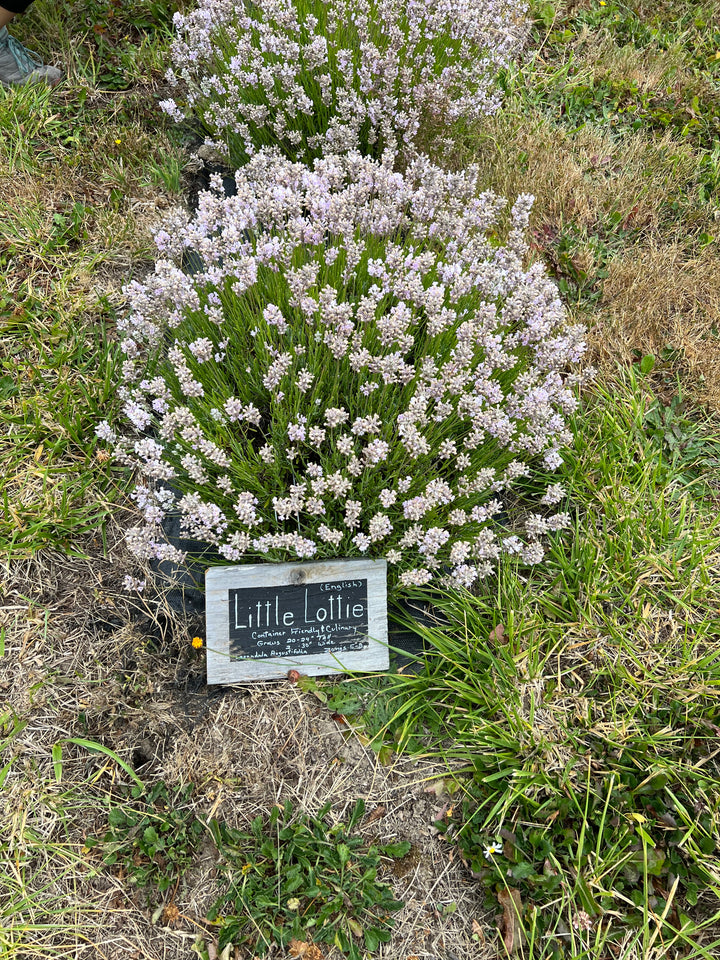
Little Lottie lavender is a dwarf English lavender, also known by its cultivar name 'Clarmo', with short pale pink flower spikes over narrow, dark gray-green foliage. It holds the Royal Horticultural Society's Award of Garden Merit. The plant grows low and wide, about 12 inches tall and 20 inches across, making a soft, evergreen cushion.
Pink English lavenders are popular for a reason. They look delicate, they mix beautifully with purple cultivars and, in Little Lottie's case, they are rated great for the kitchen too.
Little Lottie at a glance
| Trait | What to expect |
|---|---|
| Botanical name | Lavandula angustifolia 'Clarmo' (Little Lottie) |
| Flower color | Pale pink |
| Foliage | Narrow, silver-green to gray-green |
| Size | About 12 inches tall and 20 inches wide |
| Stems | About 8 inches |
| Bloom | Starts mid-June, peaks mid-July, moderate rebloom |
| Hardiness | USDA zones 5a to 10b (RHS H5) |
| Ratings | Great culinary, excellent oil suitability |
Wide, not tall
Little Lottie spreads nearly twice as wide as it grows tall, which changes how you use it. Instead of a row of separate domes, it forms a low, continuous band of soft pink when planted in a line. It is ideal for the very front of a border, along the edge of a raised bed or spilling slightly over a low wall. In containers, choose a wide, shallow pot rather than a tall one.
Plant it in front of taller purple English lavenders and you get a two-tier effect: pink below, purple above, both blooming in early summer.
Planting and spacing
Full sun and sharp drainage keep it compact and long-lived. Sandy or gravelly loam is ideal, and on clay a raised bed is the best fix. Space plants about 18 to 20 inches apart so the mounds just knit together. Set the crown at soil level and keep mulch away from the base. Check your zone with the USDA Zone Finder; at 5a to 10b, it suits most of the country.
Seasonal care
- Spring: after new growth starts, trim winter-browned tips back to green leaves.
- First summer: water deeply when the top few inches are dry.
- Bloom: enjoy the pink spikes from mid-June; harvest some for drying or cooking.
- After bloom: shear spent stems and lightly shape, staying above bare wood, for a moderate rebloom.
- Winter: it needs cold to set buds. Keep crowns dry and skip heavy mulch.
Pink lavender in the kitchen
Little Lottie is rated great for culinary use, and its pale pink buds make a pretty addition to sugar, shortbread or a lemonade garnish. Harvest when buds are colored but mostly closed, dry them out of the sun and rub them from the stems. Use only plants grown and handled as a food crop, and start with a small amount. The Harvest Calendar shows the timing.
It comes as a 3-inch plug, a 4-inch pot or a 1-gallon pot. See the product page for current sizes and availability.
Frequently asked questions
Does Little Lottie stay pink?
Yes, its flowers are documented as pale pink. Dried buds soften in color over time, as most dried flowers do.
Is Clarmo the same plant?
Yes. Clarmo is the cultivar name, and Little Lottie is the name it is sold under.
Can I grow it in a pot?
Yes. Choose a wide pot with drainage holes and a gritty mix, and leave it outdoors in a sheltered spot over winter.

































Share how it went in your field