

Use & Care NotesLavender Plants
Lusi Purple Lavender: The Classic Spanish Look in a Smaller Size
 Save
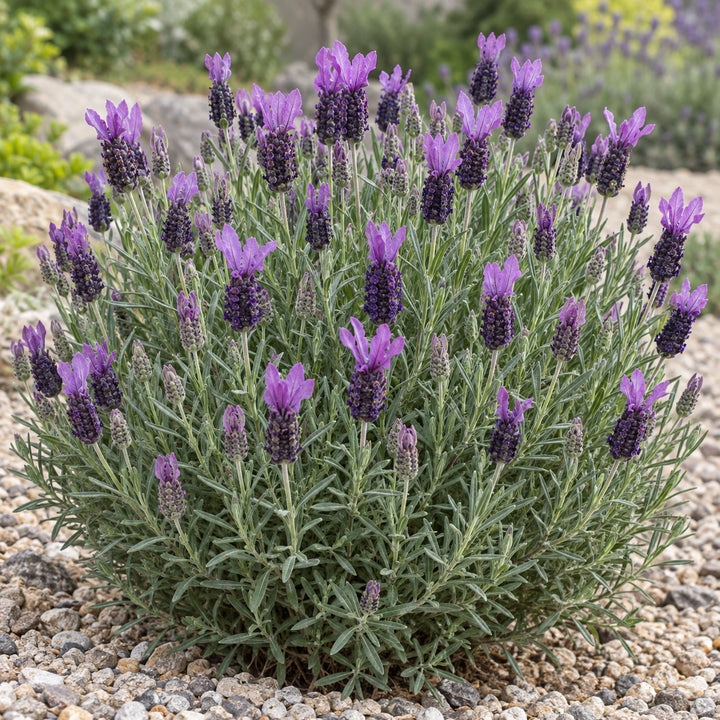
Lusi Purple lavender is the Spanish lavender most people picture: plump purple heads crowned with upright bracts, on a bushy plant with gray-green leaves. It is the most compact of the Lusi lavenders we carry, at about 16 inches tall and wide, which makes it easy to tuck into window boxes, railing planters and mid-sized pots.
Its fragrance is rated strong, bold and resinous with camphor and eucalyptus-like notes, and it blooms from early May with a high rebloom rating.
Lusi Purple at a glance
| Trait | What to expect |
|---|---|
| Botanical name | Lavandula stoechas 'Lusi Purple' |
| Flower color | Purple |
| Foliage | Gray-green |
| Size | About 16 inches tall and 16 inches wide |
| Habit | Bushy and compact |
| Bloom | Starts early May, peaks late May, high rebloom |
| Hardiness | USDA zones 7a to 9b |
| Fragrance | Strong; resinous, camphor and eucalyptus-like |
Small spaces, big color
The appeal of Lusi Purple is how much classic Spanish lavender character it packs into a modest footprint. A window box in full sun can hold two or three plants. A single plant fills a 10 to 12 inch pot. On a balcony or small deck, where every container counts, it gives you months of purple and a strong scent without crowding anything else.
Plant it with trailing silver foliage, white bacopa-style fillers or a cascade of herbs like thyme for a sunny, Mediterranean-feeling window box.
Window box and pot care
- Drainage: make sure window boxes have holes; add a layer of grit to the mix.
- Sun: six hours or more; south- or west-facing boxes are ideal.
- Water: boxes and small pots dry quickly. Check daily in July, but water only when the top inch is dry.
- Feeding: light. A little slow-release fertilizer at planting is usually enough.
- Deadheading: pinch or snip faded heads at the first leaf pair. A quick weekly tidy keeps it blooming.
Bringing it inside for winter
With a zone 7a to 9b rating and winter notes describing it as generally less cold-hardy than English lavender, Lusi Purple will not survive a Michigan winter in a box on the porch. Before hard frost, move plants into pots and bring them to a cool, bright window or sunroom. Water sparingly until spring. Its compact size makes it one of the easier Spanish lavenders to overwinter. Return it outside after the last frost; the Frost Date Estimator helps with timing.
Enjoying the flowers
It is rated good for fresh flowers and fair for dried, so enjoy it mostly in the garden and in small vases. Cut heads when the bracts are fully colored. Bees love it, and its early bloom gives them a spring option. For commercial growers, it carries a large-bundle rating for pick-your-own plantings. Culinary use is not recommended.
It comes as a 3-inch plug, a 4-inch pot or a 1-gallon pot. See the product page for current sizes and availability.
Frequently asked questions
How is Lusi Purple different from Lusi Pink and Lusi White?
Besides color, Lusi Purple is smaller, about 16 inches, while Lusi Pink and Lusi White grow to about 24 inches.
Can I grow it in a window box all summer?
Yes, with full sun, good drainage and regular deadheading it will flower through the season.
Will it come back next year outdoors?
Not in Michigan. Overwinter it indoors or replant each spring.
Keep exploring
Ready to plant it?
Sizes, prices and shipping times are on its page.



Share how it went in your field