

Use & Care NotesLavender Plants
Nana Atropurpurea Lavender: Dark Violet on Silver Foliage
 Save
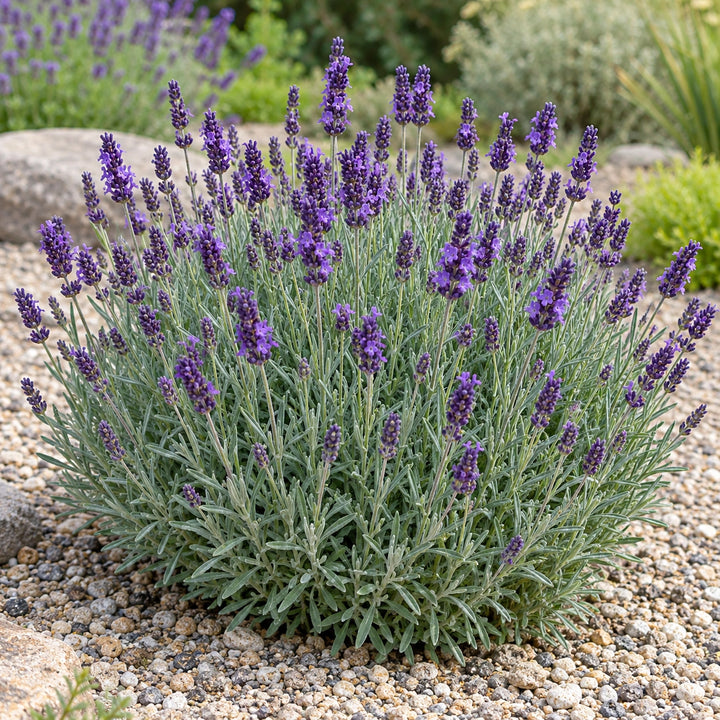
Nana Atropurpurea lavender packs deep color into a small plant. Its name roughly means dwarf dark purple, and it delivers: dark violet to violet-blue spikes over silver-gray foliage on a tidy, compact mound about 18 inches tall and wide. The scent is sweet and floral with soft herbal notes.
The silver leaves and dark flowers give it built-in contrast, so even a single plant looks finished.
Nana Atropurpurea at a glance
| Trait | What to expect |
|---|---|
| Botanical name | Lavandula angustifolia 'Nana Atropurpurea' |
| Flower color | Dark violet to violet-blue |
| Foliage | Silver-gray |
| Habit and size | Tidy and compact; about 18 inches tall and wide; stems about 8 inches |
| Bloom | Starts early June, peaks mid-July, moderate rebloom |
| Hardiness | USDA zones 5a to 9a |
| Fragrance | Sweet floral, soft herbal, low camphor |
| Culinary | Rated great |
Design ideas
Dark flowers need a light backdrop to shine, and Nana Atropurpurea brings its own in the silver foliage. Beyond that, set it against pale gravel, light stone edging or a white fence for the most drama. It looks sharp in pairs flanking steps, in a row along a sunny path, or massed in a small bed where its uniform, compact shape creates a neat carpet of violet.
Mix it with white or pink compact lavenders for a tapestry effect, keeping the darker plant toward the front where its color can be seen up close. Pollinators find the deep violet spikes easily, and deer generally pass it by, which helps in open gardens.
Planting and spacing
Choose full sun and soil that drains fast. Sandy or loamy soil is ideal; clay calls for a raised bed or a mounded planting. Space plants about 18 inches apart. Set the crown level with the soil surface, water deeply and keep organic mulch pulled back from the base. A thin layer of gravel around the crown is a good alternative.
Plan planting time with the Frost Date Estimator.
Care through the year
- Spring: wait for green growth, then tidy any winter-burned tips.
- Early June: first spikes appear; cut some for culinary buds while mostly unopened.
- Mid-July: peak bloom. Cut for bundles when about a third of the flowers are open.
- After bloom: shear lightly into the leafy growth to keep the tidy mound. A moderate rebloom may follow.
- Winter: drainage is your best defense; avoid heavy, wet mulch on the crown.
Harvest and uses
Nana Atropurpurea is rated great for culinary use. Dark buds keep their color well when dried in a shaded, airy spot and stored airtight, which makes them handsome in baking, sugar and sachets. Use only plants grown and handled as a food crop and start small. Its essential oil suitability is rated excellent, and its 8-inch stems are a comfortable length for small dried bundles.
It is offered as 3-inch plugs, 4-inch pots and 1-gallon pots. See the product page for current sizes and availability.
Frequently asked questions
What does Nana Atropurpurea mean?
Nana means dwarf and atropurpurea means dark purple, a fair description of this compact, deep-flowered lavender.
Is it hardy in cold climates?
It is rated for zones 5a to 9a. Like other English lavenders, it handles cold best in well-drained soil.
Can I grow it in a container?
Yes. Its compact size suits pots with good drainage in full sun.
















Share how it went in your field