

Use & Care NotesCompanion Plants
October Daphne Stonecrop: A Scalloped Fall Carpet for Bed Edges
 Save
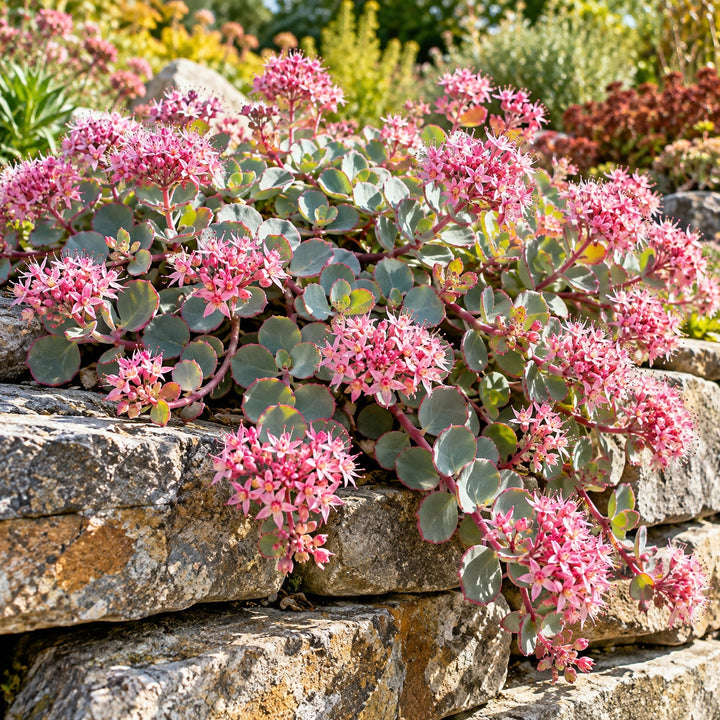
October Daphne stonecrop is a low, spreading sedum grown as much for its leaves as its flowers. Round, flat, powdery blue-green leaves about three-quarters of an inch across grow in whorls of three along arching stems, each rimmed with a thin line of deep pink that gets stronger in summer heat. In early fall, bright pink star flowers open at the stem tips, and soon after the foliage blushes pink, red, yellow and orange.
October Daphne at a glance
| Trait | What to expect |
|---|---|
| Botanical name | Hylotelephium sieboldii 'October Daphne' |
| Foliage | Round, powdery blue-green, edged deep pink; fall tones of pink, red, yellow and orange |
| Flowers | Bright pink star-shaped clusters at stem tips |
| Size | 6 to 10 inches tall, 12 to 18 inches wide |
| Bloom | Early fall |
| Hardiness | USDA zones 3 to 9 |
| Light | Full sun |
A succulent edge for lavender
Lavender beds need an edging that will not hold moisture against the lavender crowns, and October Daphne is ideal. It thrives in the same hot, sunny, well-drained ground, stays under 10 inches tall and forms a circle of scalloped stems that radiate from the center like a pinwheel. Planted along the front of a lavender bed, it gives a tidy succulent border that looks good from spring through fall.
Its blue-green leaves sit close to lavender's gray-green, and the pink rims and fall flowers add color when the lavender has been harvested. It also fits between stepping stones, in wall crevices and in rock gardens. Lay out an edge in the Companion Plant Planner.
Planting and care
- Planting: set the bare root plant with its crown at soil level in lean, gritty soil and water it in.
- Sun: full sun brings out the pink edging and the fall colors.
- Soil: average to poor and sharply drained. Wet feet are the main thing that kills it.
- Water: very drought tolerant once established.
- Tidying: trim faded flower stems after bloom for a neater mat, or leave them for winter.
Fill in by sharing pieces
October Daphne is easy to spread. Divide the clump, or replant pieces anywhere you want it to fill in, and they root readily in lean, sunny soil. That makes it simple to extend an edging over a few seasons. It is also a good fall container plant; a shallow pot of it on a sunny step makes a small show when most of the garden is winding down.
Frequently asked questions
When does it bloom?
Early fall, which is where it gets its name. The foliage color peaks soon after.
Will it crowd my lavender?
No. It stays low and only 12 to 18 inches wide, so it edges the bed without climbing into the lavender. Keep a few inches between it and each lavender crown.
Does it need winter protection?
No. It is hardy in zones 3 to 9. Drainage matters more than cold.
















Share how it went in your field