

Use & Care NotesLavender Plants
Papillon Lavender: Butterfly Lavender with Fluttering Bracts
 Save
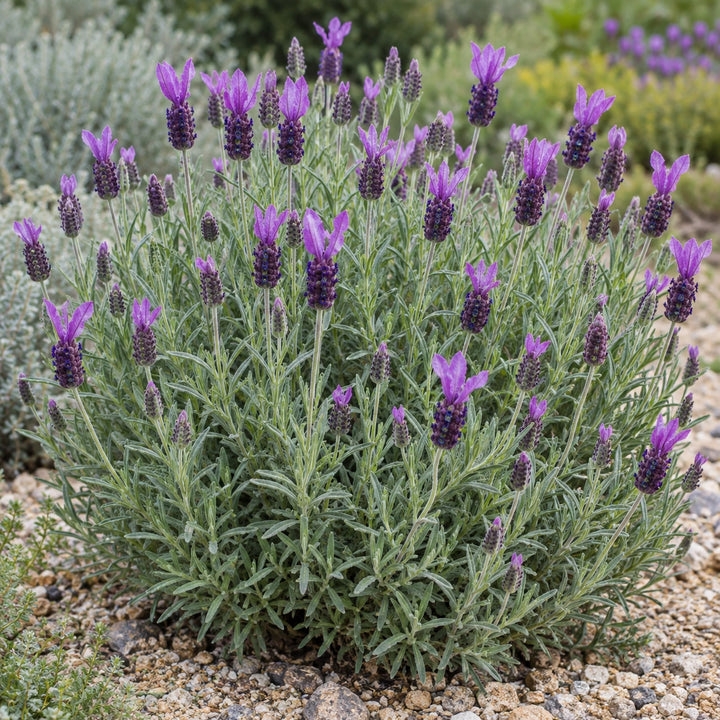
Papillon lavender is Lavandula pedunculata, often called butterfly lavender. Papillon is French for butterfly, and the name fits: its violet to purple flower heads sit atop long, bare stalks, each crowned with bracts that flutter like little wings. The plant is bushy and compact, about 24 inches tall and wide, with gray-green foliage.
It is a close relative of Spanish lavender, and it shares that group's early bloom and bold, resinous scent.
Papillon at a glance
| Trait | What to expect |
|---|---|
| Botanical name | Lavandula pedunculata 'Papillon' |
| Flower color | Violet to purple, with wing-like bracts |
| Foliage | Gray-green |
| Size | About 24 inches tall and wide |
| Bloom | Starts early May, peaks late May, high rebloom |
| Hardiness | USDA zones 7a to 9b |
| Fragrance | Bold, resinous and herbal, with camphor notes |
| Ratings | Good for cut and dried flowers; great for pollinators |
What makes butterfly lavender different
The word pedunculata refers to the flower stalk, and that long, bare stalk is what sets this species apart from typical Spanish lavender. The heads stand up and away from the foliage, so the plant looks airy and animated, especially in a breeze. Unlike many Spanish types, Papillon is also rated good for dried flowers, so the heads can go into small dried arrangements as well as fresh ones.
Containers and winter care
Papillon is rated for zones 7a to 9b, and its cold tolerance can vary with conditions. Wet winter soil is the bigger threat. In colder regions, the easiest route is a container:
- Use a terracotta or other breathable pot with drainage holes and a gritty mix.
- Set it in full sun from spring through fall.
- Before hard frost, move it to a cool, bright, frost-free spot and water sparingly.
- Return it outdoors once frost danger passes. The Frost Date Estimator helps with timing.
In zone 7 and warmer, plant it in the ground in a sunny, well-drained spot such as a gravel garden or slope.
Care for repeat bloom
- Deadhead: clip faded heads back to the foliage to keep new ones coming. Its rebloom is rated high.
- Water: regularly while rooting in, then only when the top few inches are dry.
- Feed: lightly, if at all.
- Trim: shape lightly after a big flush, avoiding cuts into bare wood.
Cutting, drying and formats
Cut Papillon for small vases when the bracts are fully open; the long stalks make it easy to arrange. For drying, cut a little earlier and hang small bunches in a dark, airy spot. It is not recommended for culinary use. Pollinators love it, and deer tend to avoid it.
It is offered as 3-inch plugs, 4-inch pots and 1-gallon pots. See the product page for current sizes and availability.
In a mixed container, let Papillon stand in the center where the long stalks can rise above lower trailing plants. Choose partners that like the same lean, dry mix so nobody in the pot is overwatered.
Frequently asked questions
Is Papillon a Spanish lavender?
It is a close cousin. Papillon is Lavandula pedunculata, butterfly lavender, while Spanish lavender is Lavandula stoechas. Both have topknot bracts.
Does it dry well?
Yes, better than many Spanish types. It is rated good for dried flowers.
Can it stay outside all winter in Michigan?
Usually not. It is rated for zones 7a to 9b, so shelter potted plants for winter in colder zones.
















Share how it went in your field