

Product Field NotesCompanion Plants
Peachie's Pick Stokes' Aster: Late Lavender-Blue Discs for Cutting
 Save
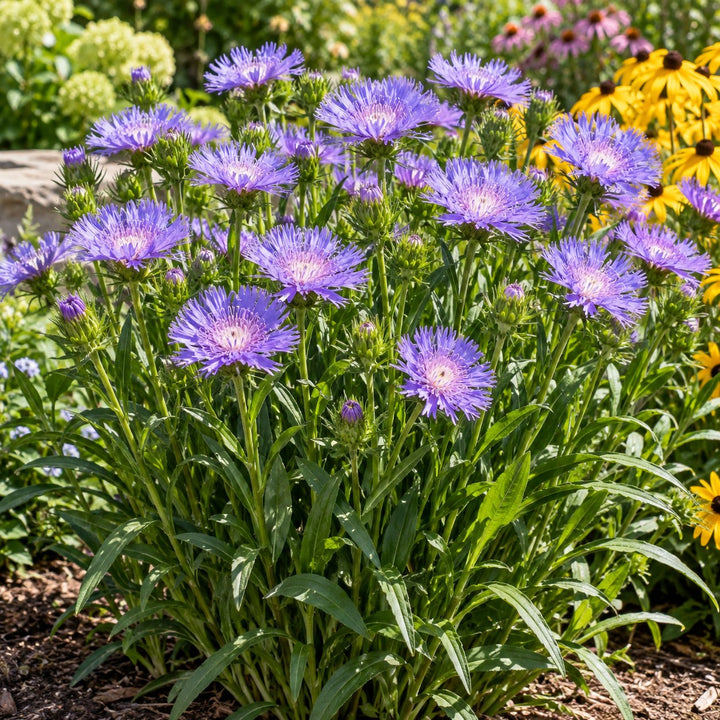
Peachie's Pick Stokes' aster carries flat, cornflower-like flowers 3 to 4 inches across in soft lavender-blue. An outer ring of broad petals, fringed at the tips, surrounds a lacy center of finely cut florets, so each bloom looks a bit like a frilly disc. It flowers a little later and longer than most Stokes' asters, and its longer stems make it one of the better choices for cutting.
It is an easy, dependable native wildflower with deep green leaves that stay healthy all season.
Peachie's Pick at a glance
| Trait | What to expect |
|---|---|
| Botanical name | Stokesia laevis 'Peachie's Pick' |
| Flowers | 3 to 4 inches, soft lavender-blue with fringed petals |
| Foliage | Deep green, lance-shaped, in a basal clump |
| Size | About 18 inches tall, 18 to 24 inches wide; flower stems can reach about 2 feet |
| Bloom | Starts mid-July, peaks early August, moderate rebloom |
| Hardiness | USDA zones 5 to 9 |
| Light | Full sun |
| Wildlife | Great for pollinators and butterflies |
Carrying the lavender theme into fall
Stokes' aster shares lavender's liking for full sun and soil that drains, so it can sit in the same bed or right beside it. The real value is timing and color. Peachie's Pick starts in mid-July and peaks in early August, just as many lavender beds have been harvested or sheared, and its lavender-blue discs keep the purple-blue theme going for weeks afterward.
The broad, flat flowers are also a nice change of shape next to lavender's spikes. Pair it with yellow, pink or white late bloomers for a fuller late-summer border. Plan it in the Companion Plant Planner.
Planting and care
- Soil: well drained; it adapts to poor or fertile ground.
- Water: regular the first season, then only in long dry spells. It is very heat tolerant.
- Deadheading: remove spent flowers to keep new buds opening into early fall.
- Winter: hardy in zone 5 Michigan gardens when the soil drains well. Leave the basal rosette in place over winter, mulch lightly after the ground freezes in colder spots and clean up dead leaves in spring.
- Problems: few diseases; crown rot in wet winter soil is the main risk.
For the cutting garden
Its long, sturdy stems are why this selection is a favorite for bouquets. Cut flowers when they are just open and get them into water quickly. Lavender-blue Stokes' aster with late lavender stems makes a cohesive, cool-toned arrangement. The Cut Flower Planner can help you time a late-summer cutting bed.
About the plug tray
It is offered as a full 72-cell plug tray, a good fit for native plantings, pollinator borders and cutting rows. See the product page for current availability.
Frequently asked questions
Is Stokes' aster native?
Yes. It is a native wildflower of the southeastern United States that grows well in zone 5 gardens with good drainage.
Why is it different from seed-grown Stokes' aster?
Peachie's Pick is more uniform and vigorous, with a tight clump and sturdy upright stems.

































Share how it went in your field