

Product Field NotesCompanion Plants
Perfect Profusion Salvia: Icy Blue Spires That Keep Reblooming
 Save
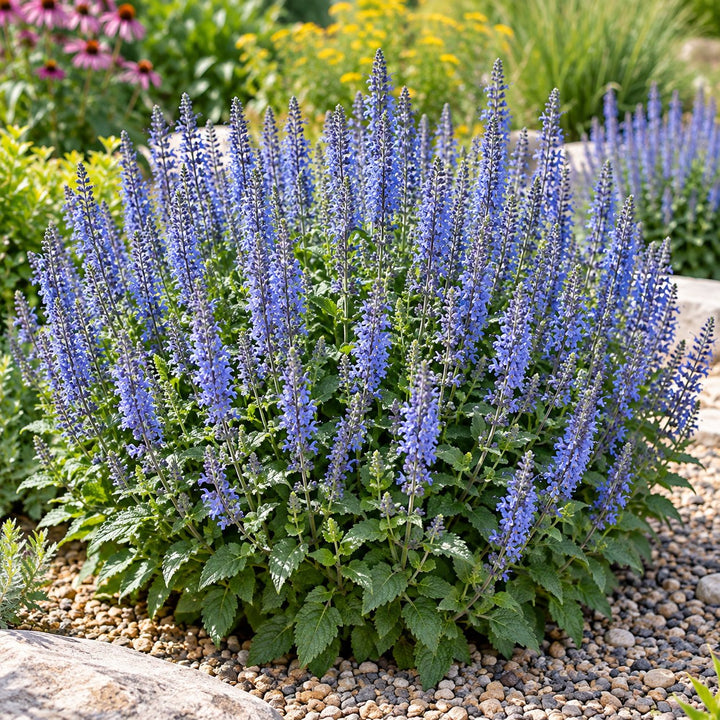
Perfect Profusion salvia forms a uniform, rounded dome 16 to 20 inches tall and wide, covered in slender spikes of soft icy blue flowers. What makes it stand out is the sheer number of spikes: they pack the top of the plant so densely that it looks like a round cushion of pale blue spires, visible from across the yard.
It is also one of the most reliable salvias for rebloom. Cut it back after each flush and it comes again, often several times a summer.
Perfect Profusion at a glance
| Trait | What to expect |
|---|---|
| Botanical name | Salvia nemorosa 'Perfect Profusion' |
| Flowers | Soft icy blue, on dense 4 to 6 inch spikes |
| Foliage | Green, crinkled, mild sage-like scent when brushed |
| Size | 16 to 20 inches tall and wide |
| Bloom | Starts late May, peaks mid-June, high rebloom |
| Hardiness | USDA zones 3 to 8 |
| Light | Full sun |
| Wildlife | Excellent for bees and butterflies; deer and rabbit resistant |
The spike that fills lavender's gaps
Salvia and lavender look like cousins in the garden, and they behave like them too: full sun, lean soil, little water once established. That makes Perfect Profusion one of the most natural partners for a lavender bed. Its upright spikes echo lavender's form, while the icy blue reads cooler and paler than lavender's purple, so the two layer nicely without blurring together.
The bigger benefit is timing. It starts in late May, before most lavender opens, overlaps in June and then keeps reblooming after the lavender harvest. Use it as an edger in front of lavender or alternate small groups with lavender along a path. Lay it out in the Companion Plant Planner.
The shearing routine
- When most spikes on the plant have faded, shear the whole dome back by about a third.
- Water once after shearing if the weather is dry.
- New spikes follow in a few weeks; repeat after each flush through summer.
It is a quick job with hand shears, and it is the difference between one show and several.
Care through the year
- Soil: average and well drained. Wet, heavy soil in winter is the main cause of loss.
- Feeding: skip it. Lean soil keeps the dome tight.
- Winter: reliably hardy in Michigan. Leave stems standing over winter or cut back in fall, then clean up old growth in spring as new leaves appear.
Frequently asked questions
Can I cook with this salvia?
No. It is an ornamental sage, not a culinary one.
Is it good near beehives?
Yes. It has an excellent pollinator rating and blooms over a long season, a good match for lavender in a bee garden. Our Beekeeper Tools can help with planning.















Share how it went in your field