

Product Field NotesCompanion Plants
Peter Cottontail Yarrow: Airy White Pom-Poms Around Lavender
 Save
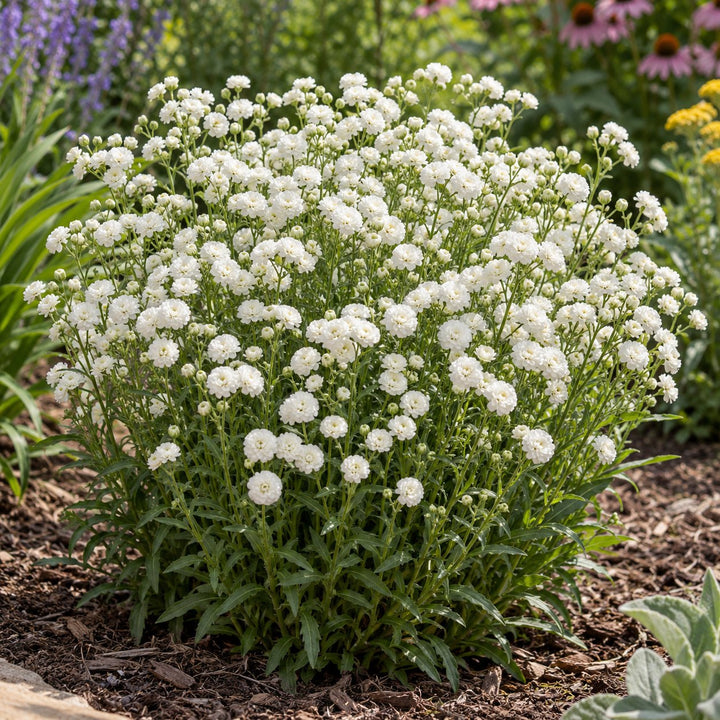
Peter Cottontail yarrow is a sneezewort type, Achillea ptarmica, with a softer, airier look than the familiar flat-topped yarrows. Instead of dense plates, it carries loose sprays of small, fully double ivory white flowers with button-like ruffled centers. From a distance they read almost like baby's breath; up close, each one is a tiny pom-pom.
The plant stays a low, polished mound under 2 feet tall and blooms for a long stretch from early summer toward fall.
Peter Cottontail at a glance
| Trait | What to expect |
|---|---|
| Botanical name | Achillea ptarmica 'Peter Cottontail' |
| Flowers | Double ivory white buttons, about 0.5 to 0.75 inch, in loose sprays |
| Foliage | Narrow, lance-shaped, finely toothed green leaves |
| Size | 18 to 24 inches tall, 28 to 30 inches wide |
| Bloom | Starts mid-June, peaks mid-July, moderate rebloom |
| Hardiness | USDA zones 3 to 8 |
| Light | Full sun to part shade |
| Deer and rabbits | Resistant |
Softening the lavender's edges
Lavender is tidy and structured. Peter Cottontail is loose and frothy. Put the two together and the white sprays blur the edges of a lavender row in a way that feels natural rather than planned. White is also the easiest companion color for purple; it brightens the lavender without competing.
It likes the same sunny, well-drained ground as lavender, and it is a bit more forgiving of moisture than common yarrow, so it handles the slightly richer soil at the bed's edge or along a path. Its bloom starts in mid-June, overlaps lavender and keeps filling gaps after the first lavender flush. Plan it in the Companion Plant Planner.
Planting and care
- Soil: average and well drained. Wet winter soil causes crown rot.
- Water: regular the first season, then it tolerates dry spells.
- Deadheading: light shearing of faded sprays keeps the mound neat and the flowers coming.
- Winter: reliably hardy in Michigan. Cut spent stems back to the basal foliage in fall or spring; no mulch needed.
A bouquet maker
This is where Peter Cottontail shines. It is rated excellent as a cut flower and good for drying. Cut sprays when most flowers are open, then use them fresh as a filler or hang them upside down in a shaded, airy spot to dry. Tiny white pom-poms tucked among dried lavender stems make a sweet farmhouse bundle. Use the Cut Flower Planner to time your cutting.
Plug tray or bare root
It is offered as a 72-cell plug tray for edging and mass plantings and as a bare root plant for a single clump. See the product pages for current availability.
Frequently asked questions
Will it spread like common yarrow?
It forms a compact, dense mound. Its flowers are mostly sterile, so it is not known for seeding around.
Can it grow in a container?
Yes. Its tidy size suits containers in sun or part shade.

































Share how it went in your field