

Use & Care NotesLavender Plants
Peter Pan Lavender: A Low, Dark English Lavender for Drying
 Save
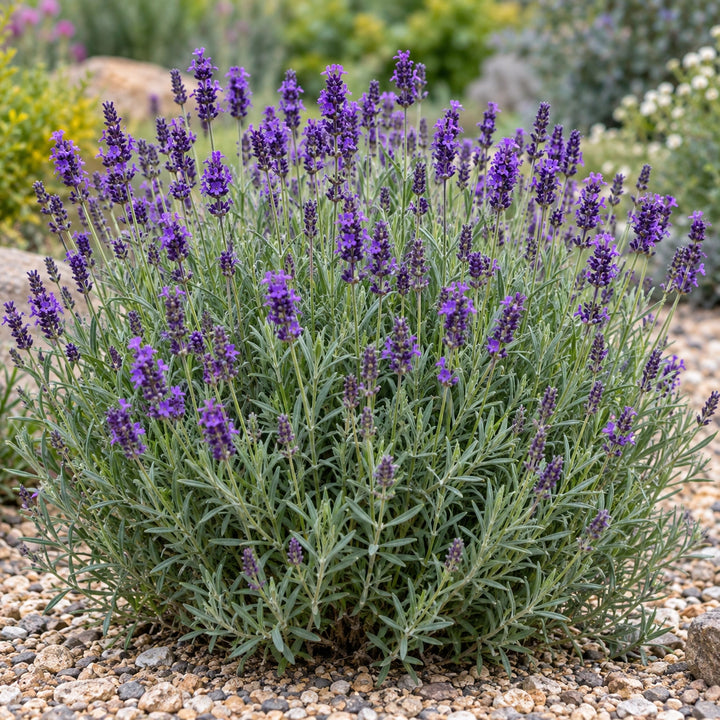
Peter Pan lavender is a low-growing English lavender with dark violet spikes and vibrant violet flowers over aromatic gray-green, evergreen foliage. It forms a bushy mound about 18 inches tall and up to 30 inches wide, with stems of roughly 8 to 10 inches.
Its history has a twist. It was distributed in the 1990s under the name Twickel Purple, then recognized as its own distinct cultivar and renamed Peter Pan in 2001. Fitting, for a plant that refuses to grow up very far.
Peter Pan at a glance
| Trait | What to expect |
|---|---|
| Botanical name | Lavandula angustifolia 'Peter Pan' |
| Flower color | Dark violet spikes with vibrant violet flowers |
| Foliage | Aromatic gray-green, evergreen |
| Size | About 18 inches tall and 30 inches wide; stems about 8 to 10 inches |
| Bloom | Begins late June to mid-July, peaks early to mid-July; moderate rebloom |
| Hardiness | USDA zones 5a to 9b; RHS hardiness rating H5 |
| Fragrance | Moderate |
| Best uses | Dried flowers, essential oil, culinary |
Why gardeners choose it
Dark lavenders are the ones that read from across the yard, and Peter Pan does it at a low height. Use it to edge a path, line the front of a sunny border or fill a raised bed where a taller lavender would block the view. Its spread is wider than its height, so a row knits into a low, dark violet band. In containers, it stays proportionate to a medium pot.
Planting and care
- Sun: full sun, six to eight hours or more.
- Soil: sandy, loamy or gravelly, and fast-draining. Raise beds in clay.
- Spacing: about 24 inches for an edge, a little more for separate mounds.
- Water: deeply when the top few inches dry during the first season, then sparingly.
- Pruning: shear after the main bloom, cutting into leafy growth but not bare wood. A moderate rebloom may follow.
- Winter: keep mulch and leaves off the crown.
Check the Pruning Calendar for timing in your area.
Drying and harvest
Peter Pan is rated excellent for dried flowers, and dark violet spikes hold their color well when dried properly. Cut on a dry morning when the spikes are fully colored and only a few flowers have opened. Bundle small, hang upside down in a dark, airy spot and store finished bundles out of direct sun. The 8 to 10 inch stems suit mini bundles, wreath work and sachets.
It is also rated great for culinary use. Harvest buds at the same stage, dry well and start with small amounts. Use only plants grown and handled as a food crop. Bees visit it reliably, and deer tend to leave it alone.
It is offered as 3-inch plugs, 4-inch pots and 1-gallon pots. See the product page for current sizes and availability.
For a two-tone edge, alternate Peter Pan with a white or pink compact English lavender. Its dark spikes make lighter flowers look brighter, and the similar heights keep the row even.
Frequently asked questions
Is Peter Pan the same as Twickel Purple?
No. It was once distributed under that name but was recognized as a distinct cultivar and renamed Peter Pan in 2001.
How tall does it get?
About 18 inches tall and up to 30 inches wide, making it a low-growing English lavender.
Is it good for drying?
Yes. It is rated excellent for dried flowers, and the dark spikes keep their color well.
















Share how it went in your field