

Product Field NotesCompanion Plants
Pink Lemonade False Indigo: Yellow-to-Raspberry Spikes Before Lavender
 Save
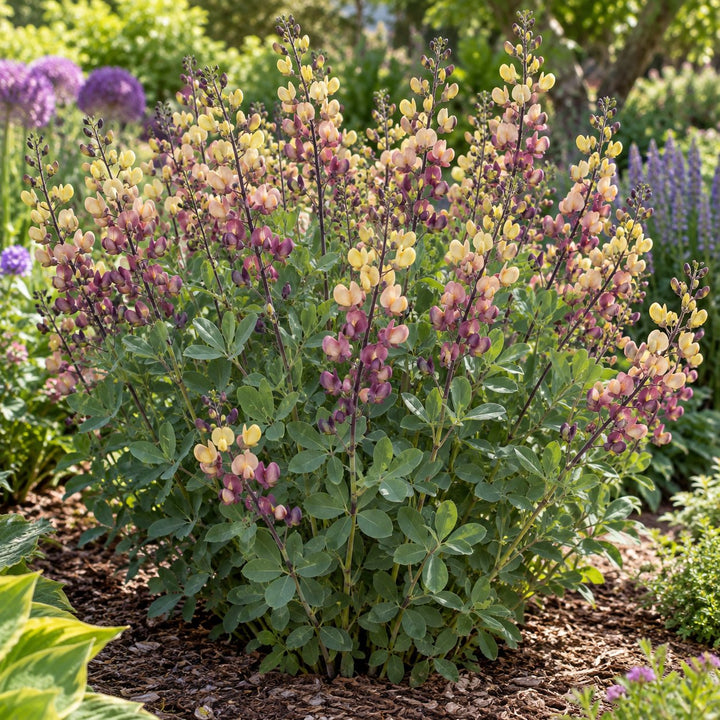
Pink Lemonade false indigo blooms in two colors at once. Its pea-shaped flowers open soft butter yellow and age to a dusty raspberry purple, so every spike shows both shades on dark charcoal stems. Underneath sits a full, bushy mound of blue-green leaves that grows to roughly the size of a small shrub.
For a lavender garden, it offers two things lavender cannot: height and a late-spring color show that arrives just before the lavender takes over.
Pink Lemonade at a glance
| Trait | What to expect |
|---|---|
| Botanical name | Baptisia 'Pink Lemonade' |
| Flowers | Soft yellow aging to dusty raspberry purple, on 10- to 12-inch spikes |
| Foliage | Three-parted, blue-green leaflets |
| Size | 42 to 48 inches tall, about 4 feet wide |
| Bloom | Starts late May, peaks early June, single flush |
| Hardiness | USDA zones 4 to 9 |
| Light | Full sun to part shade |
| Wildlife | Great for pollinators; deer resistant |
A relay race of color
False indigo hits its peak in early June, and most English lavenders start their show a little later. Planted together, Pink Lemonade hands the baton to the lavender: yellow and raspberry spikes first, then the purple wave. After bloom, its blue-green leaves make a clean backdrop for lavender's gray foliage for the rest of the season.
Because it grows to about 4 feet in each direction, plan for it like a shrub. Set it at the back of the bed or at a corner, and leave enough room that it does not shade or crowd nearby lavender. One plant can anchor a whole lavender planting.
Planting for the long haul
False indigo grows a deep taproot, which is what makes it so drought tolerant once established and so unhappy about being moved later. Pick its spot carefully the first time.
- Soil: lean to average and well drained, the same ground lavender likes.
- Patience: expect a couple of seasons before it fills out. After that it is very long lived.
- Spacing: give it room for air to move so the leaves stay clean after bloom.
- Fall: cut it down in late fall, or leave the dark seed pods standing for winter interest.
It is fully hardy in Michigan without winter protection. Soggy winter soil is the main cause of loss, the same as with lavender.
Cutting the spikes
The flower spikes are good in arrangements, and the charcoal stems make the two-tone flowers stand out in a vase. The seed pods dry fairly well for fall bundles, too.
Plug tray or bare root
Pink Lemonade is offered as a 72-cell plug tray for growers and larger plantings, and as a bare root plant for setting straight into the garden. See each product page for current availability.
Frequently asked questions
Why is my false indigo slow the first year?
It is busy building that deep taproot. Top growth usually catches up in the next season or two.
Can I eat it or use it like real indigo?
No. It is an ornamental only. False indigo contains alkaloids and is considered mildly toxic if eaten.
Do deer eat it?
Deer tend to leave it alone, which makes it a dependable partner for lavender in rural gardens.

































Share how it went in your field