

Use & Care NotesLavender Plants
Platinum Blonde Lavender: Bright Foliage and Soft Blue Spikes
 Save
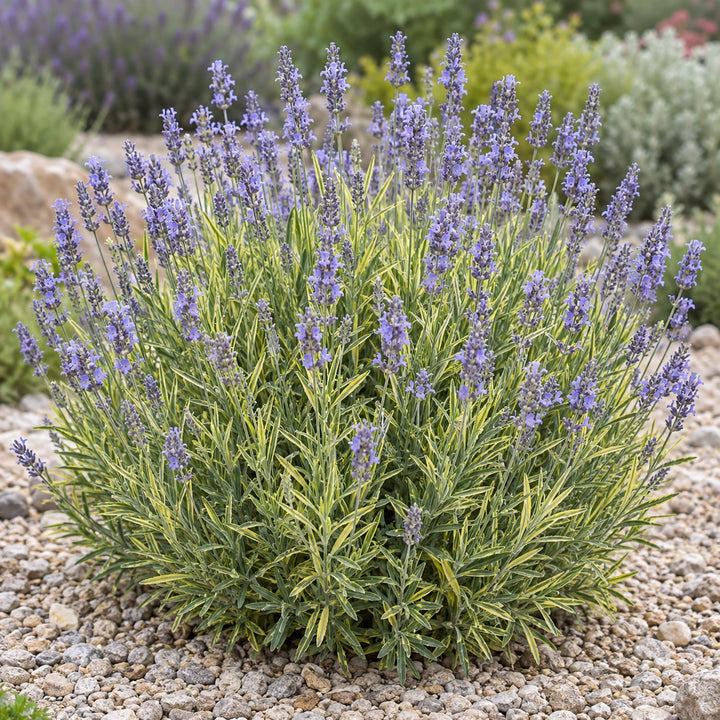
Platinum Blonde lavender, also known as Momparler, is an English lavender you notice before it ever blooms. Its foliage mixes green and soft yellow, giving the plant a light, bright look all season. In midsummer it adds soft blue to pale lilac-purple spikes on a dense, compact mound about 18 inches tall and wide.
It is the lavender for people who like their plants to look good on the days they are not flowering, which is most of them.
Platinum Blonde at a glance
| Trait | What to expect |
|---|---|
| Botanical name | Lavandula angustifolia 'Momparler' |
| Also sold as | Platinum Blonde |
| Flower color | Soft blue to pale lilac-purple |
| Foliage | Green and yellow tones |
| Size | About 18 inches tall and wide; stems about 9 inches, spikes about 4.9 inches |
| Bloom | Starts mid-June, peaks mid-July, moderate rebloom |
| Hardiness | USDA zones 5a to 9b; RHS hardiness rating H5 |
| Fragrance | Sweet floral, soft herbal, low camphor |
Designing with bright foliage
Most lavender foliage sits in the gray-green range. Platinum Blonde's lighter, yellow-toned leaves stand out against dark mulch, green lawns and deep purple flowers. Use it to brighten the front of a border, to add contrast in a container, or to repeat along a path so the eye follows the light patches. It pairs well with deep violet lavenders, whose dark spikes look striking beside its pale leaves.
Because it stays compact and dense, it also works in formal settings: knot gardens, low edges and symmetrical pots flanking a door. In a container, the bright leaves carry the show in spring and fall, and the blue-lilac spikes take over in summer. Pollinators visit it often in bloom, and deer tend to pass it by, as they do most lavenders.
Planting and care
- Light: full sun keeps the foliage color bright and the plant dense.
- Soil: sandy or loamy and fast-draining. Raised beds help in clay.
- Spacing: about 18 inches apart.
- Water: deeply during establishment, then sparingly. Overwatering is the most common mistake.
- Feeding: light. Lean soil keeps it compact.
- Pruning: shear after bloom to keep the tidy mound, staying in the leafy growth.
The Plant Care Guide covers the basics for every lavender in more depth.
Flowers, harvest and uses
The spikes are a gentle blue-lilac and run nearly five inches long, which is generous for a compact plant. Platinum Blonde is rated great for culinary use, with the sweet, low-camphor profile typical of English lavender. Harvest buds when colored but mostly unopened, dry in the shade and store airtight. Use only plants grown and handled as a food crop. Its essential oil suitability is rated excellent, and the flowers are good for small cut and dried bundles.
It is offered as 3-inch plugs, 4-inch pots and 1-gallon pots. See the product page for current sizes and availability.
Frequently asked questions
Is Platinum Blonde the same as Momparler?
Yes. Momparler is the cultivar name, and Platinum Blonde is the name it is often sold under.
Will the foliage stay yellow-toned all year?
It is grown for its green-and-yellow foliage. Plants in full sun and lean soil keep the brightest color.
Is it hardy in Michigan?
It is rated for zones 5a to 9b with an H5 hardiness rating, which covers most of lower Michigan when the soil drains well.
















Share how it went in your field