

Product Field NotesLavender Plants
Premier Lavender: A Larger English Lavender with Green Leaves
 Save
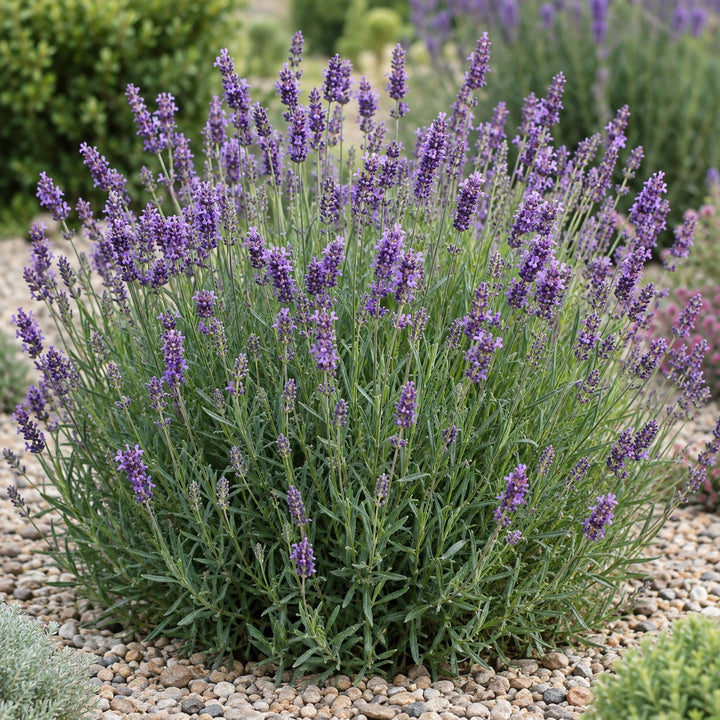
Premier lavender is a larger English lavender with an upright, bushy habit, about 30 inches tall and 36 inches wide. Its purple spikes rise over foliage that leans green rather than gray, and it flowers early, starting in early June and peaking by mid-June, with the sweet, low-camphor scent of English lavender.
It is English lavender with some stature, useful when a compact type would get lost in a big bed.
Premier at a glance
| Trait | What to expect |
|---|---|
| Botanical name | Lavandula angustifolia 'Premier' |
| Flower color | Purple |
| Foliage | Green |
| Habit and size | Upright and bushy; about 30 inches tall and 36 inches wide |
| Bloom | Starts early June, peaks mid-June, moderate rebloom |
| Hardiness | USDA zones 5a to 9b |
| Fragrance | Sweet floral, soft herbal, low camphor |
| Culinary | Rated great |
English lavender at a bigger scale
Many English lavenders top out around 18 to 24 inches. Premier's extra height and width let it hold its own in larger borders, along long fence lines and as a substantial informal hedge, while keeping the sweeter fragrance and culinary quality of English lavender. Its green foliage gives a fresher look than silver-leaved types and transitions nicely to lawns and green-leaved shrubs.
Because it peaks in mid-June, plant it alongside July and August bloomers for a long season. The Lavender Bloom Calendar lines up the options.
Planting and spacing
- Sun: full sun, six to eight hours or more.
- Soil: sandy or loamy and quick to drain. Raised beds or mounded rows help in clay.
- Spacing: about three feet apart for airflow, a little closer for a solid hedge.
- Planting: crown level with the soil; water deeply after planting.
- First season: water when the top few inches of soil dry. Afterward, water needs are low.
Care through the year
In spring, wait for new green growth before tidying winter-damaged tips. After the June bloom, shear the plant lightly into a rounded shape, cutting into leafy stems but not into bare wood. That trim keeps a larger English lavender from opening up in the center and can bring a moderate rebloom. Skip heavy fertilizer, which makes tall lavenders floppy. Over winter, keep wet mulch and leaves off the crown; drainage is what carries English lavender through cold, wet seasons.
Harvest and uses
Premier is rated great for culinary use. Harvest buds in June when spikes are colored but only a few flowers have opened. Dry in the shade, rub off the buds and store airtight. Use only plants grown and handled as a food crop, and start with small amounts. Its essential oil suitability is rated excellent, and its stems work for fresh posies and dried bundles. It is great for pollinators and resistant to deer.
It is offered as 3-inch plugs, 4-inch pots and 1-gallon pots. See the product page for current sizes and availability.
If you are planting Premier as a hedge, set out a string line first so the row stays straight, and plant all of the plants at the same depth. Even spacing and depth help the row mature into a uniform, continuous mound.
Frequently asked questions
Is Premier a lavandin?
No. It is an English lavender, Lavandula angustifolia, on the larger side for its group.
When should I harvest Premier?
In June, during its early to mid-June bloom. Cut early for culinary buds.
Is it hardy in zone 5?
Yes. It is rated for zones 5a to 9b. Well-drained soil is the key in cold, wet winters.

































Share how it went in your field