

Use & Care NotesCompanion Plants
Sassy Summer Sangria Yarrow: Wine-Red Domes Behind Lavender
 Save
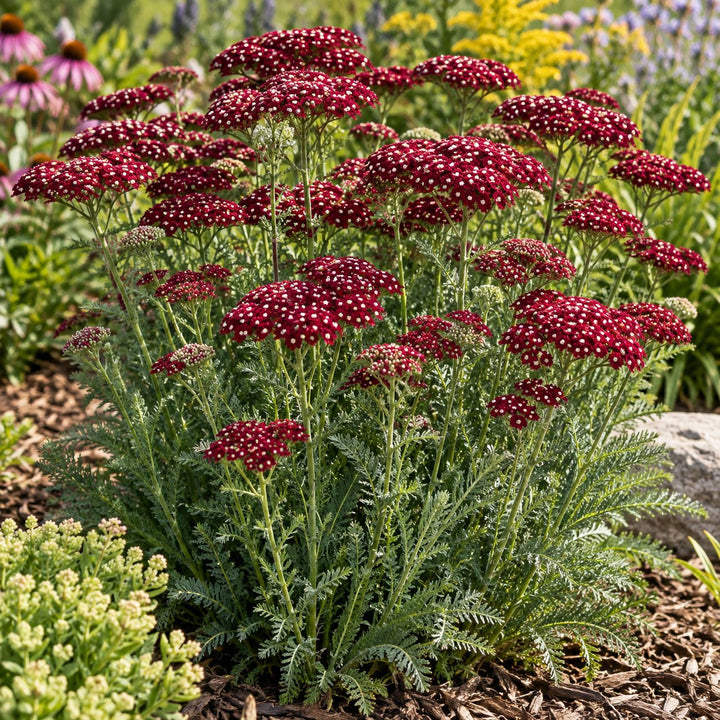
Sassy Summer Sangria yarrow is one of the tallest plants in its series, with broad clusters of deep wine red to dark raspberry florets, each marked with a tiny white eye. Up close the heads look slightly speckled; from across the yard they read as rich, dark red domes over pale, silvery foliage.
It is the yarrow we would reach for to put some depth behind a row of lavender. Sangria for the garden, no corkscrew required.
Sassy Summer Sangria at a glance
| Trait | What to expect |
|---|---|
| Botanical name | Achillea 'Sassy Summer Sangria' |
| Flowers | Dark wine red with small white eyes, 3 to 5 inch clusters |
| Foliage | Silvery green, feathery |
| Size | 30 to 36 inches tall, 36 to 42 inches wide |
| Bloom | Starts mid-June, peaks early July, repeats when sheared |
| Hardiness | USDA zones 3 to 8 |
| Light | Full sun |
| Wildlife | Excellent for pollinators; deer resistant |
Where it fits in a lavender garden
Dark red and purple are close cousins, so this pairing feels moody and layered rather than high-contrast. The silvery leaves tie the yarrow to lavender's gray foliage, which keeps the planting from looking busy. Put Sangria behind compact lavenders, where its height lifts the eye, and let the two overlap in bloom through early summer.
It also handles tough spots. Drought, salt and poor soil do not faze it once it is established, so it works along a driveway edge or a sunny slope where lavender is already thriving. For a prairie-style planting, pair it with ornamental grasses and let it mingle.
Care notes
- Soil: lean to average and well drained. Wet winter soil is the main cause of crown rot.
- Water: regularly through the first season, then only in long dry spells.
- Airflow: powdery mildew and gray mold can show up in wet, crowded sites, so space it generously.
- Shearing: the flowers hold their color well, then soften. Cut back by about half after the first flush to bring on more blooms.
- Winter: reliably hardy in Michigan; trim spent stems back to the basal leaves in fall or spring. No mulch needed.
In the vase
The stiff, branched stems are good for cutting. For fresh arrangements, pick heads that are fully open, since buds cut too early tend to wilt. For drying, hang small bunches in a dark, airy room to hold as much of the red as possible. Dark red yarrow with lavender makes a bundle with real depth.
Plug tray or bare root
Sangria comes as a 72-cell plug tray, which suits growers and big plantings, and as a single bare root plant for the home border. See each product page for current availability.
Frequently asked questions
Does the red fade?
Yarrow colors naturally soften as the flowers age. Sangria holds its dark red well before mellowing, and shearing brings on fresh heads.
Will it flop?
Its stems are stiff, but rich soil or extra water can still make it lean. Lean ground keeps it upright.
Is it good in a seaside or roadside garden?
It tolerates salt and poor soil, so it is a solid choice for exposed, sunny edges.
















Share how it went in your field