

Product Field NotesCompanion Plants
Smoke Signal Little Bluestem: A Native Column That Turns Red in Fall
 Save
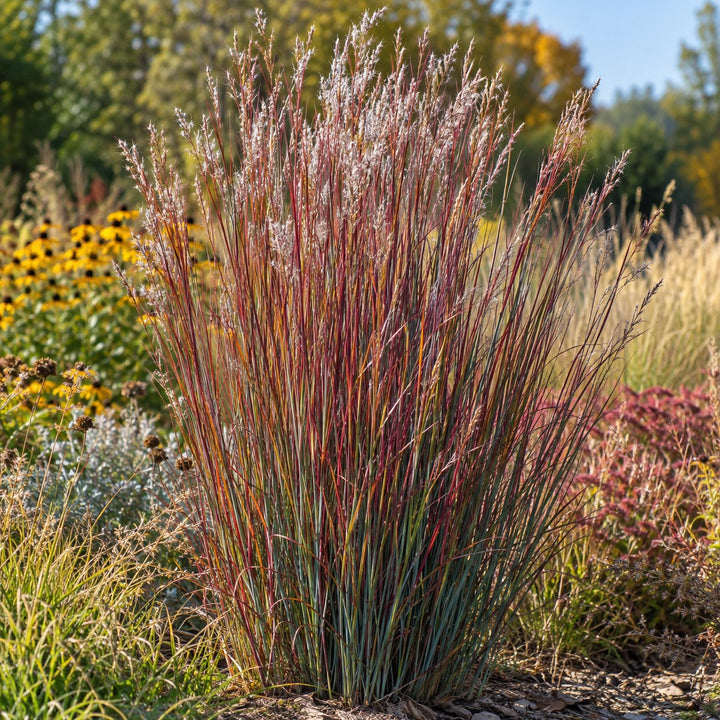
Smoke Signal little bluestem is a refined form of a native prairie grass. Its narrow, powdery blue-green blades grow in a strictly vertical clump that does not arch or flop, even in fall. In late summer the color starts shifting to scarlet, deepening to red-purple as fall goes on, and tiny tan seed heads with fluffy silver tufts line the upper stems.
It thrives in exactly the lean, dry, sunny ground lavender loves, which makes it one of the easiest grasses to combine with a lavender planting.
Smoke Signal at a glance
| Trait | What to expect |
|---|---|
| Botanical name | Schizachyrium scoparium 'Smoke Signal' |
| Foliage | Blue-green, turning scarlet then red-purple in fall |
| Seed heads | Tiny tan heads with silver tufts |
| Size | 36 to 48 inches tall, 18 to 24 inches wide |
| Bloom | Early to mid-September, holding into winter |
| Hardiness | USDA zones 3 to 9 |
| Light | Full sun |
| Wildlife | Deer resistant |
A frame for lavender in every season
In summer, the blue-green blades sit in the same cool color family as lavender's silver foliage, and their fine vertical lines echo lavender's flower spikes at a taller scale. After the lavender harvest, Smoke Signal takes over, warming to scarlet and red-purple just as the rest of the garden fades. Through winter it stands as a red-brown column flecked with silver, a nice backdrop for lavender's evergreen mounds.
Because it is narrow, under two feet wide, it can be used as a rhythm plant: one clump behind every two or three lavenders along a long bed. It also handles drought and salt, so it works along driveways and roadsides. Plan the spacing in the Companion Plant Planner.
Planting and care
- Soil: lean to average and well drained. Wet, rich soil can cause flopping or crown rot.
- Water: through the first season; after that it is very drought tolerant.
- Feeding: none. Fertilizer makes little bluestem soft and floppy.
- Humid summers: rust can appear; good spacing and airflow help.
- Winter: very cold hardy in Michigan. Leave the stems standing for color and structure.
- Early spring: cut it back to a few inches before new growth starts.
Cutting and drying
The silvery seed heads dry well. A few fall stems of Smoke Signal tucked into a bundle of dried lavender add color and a soft, feathery texture.
Format
Smoke Signal is offered as a full 72-cell plug tray, a good choice for native plantings, meadow areas, long borders and growers. Large plantings can start at the Wholesale Hub. See the product page for current availability.
Frequently asked questions
Is little bluestem native?
Yes. Little bluestem is a native prairie grass. Smoke Signal is a selected form with a strictly upright habit and strong fall color.
Will it flop over like other grasses?
Not in lean soil. It is chosen for staying upright through fall. Rich, moist soil is what makes it lean.
When does it look best?
It is good all season, but fall, when it turns scarlet and red-purple, is its showpiece.

































Share how it went in your field