

Product Field NotesCompanion Plants
Solar Flare Red Hot Poker: Sunny Yellow Torches Behind Lavender
 Save
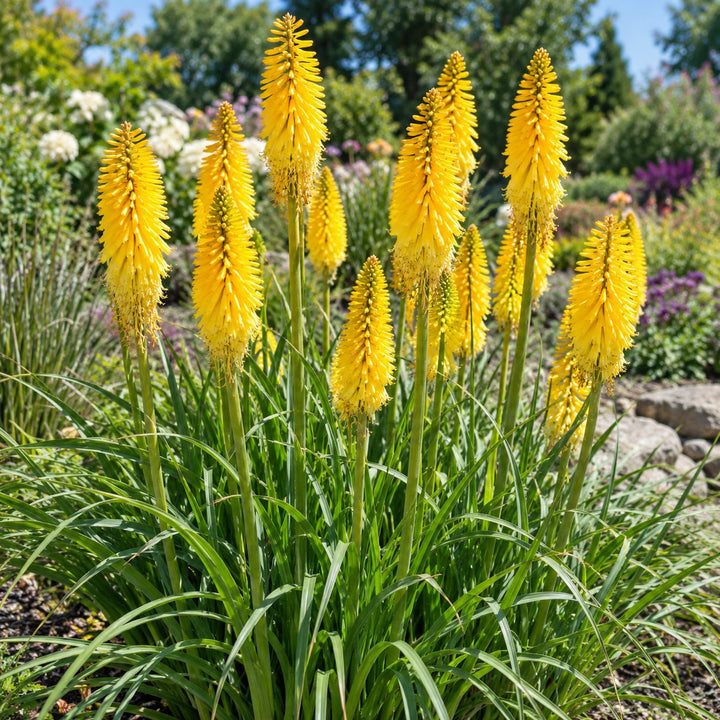
Solar Flare red hot poker breaks the usual two-tone red hot poker pattern. Its club-shaped spikes are a solid, even sunny yellow from bud to open flower, held on tall, stout, bare stems above an upright clump of arching, grassy leaves. Several torches rise at once, and with spent spikes removed it can keep sending up new ones from early summer into early fall.
Despite the name, there is nothing red about it. Gardeners have learned to live with this.
Solar Flare at a glance
| Trait | What to expect |
|---|---|
| Botanical name | Kniphofia 'Solar Flare' |
| Flowers | Solid bright sunny yellow torches |
| Foliage | Green to gray-green, long, arching and grassy |
| Size | 36 to 42 inches tall in flower, 24 to 30 inches wide |
| Bloom | Starts late June, peaks mid-July, repeats into early fall |
| Hardiness | USDA zones 6 to 9 |
| Light | Full sun |
| Wildlife | Great for hummingbirds and pollinators; moderately deer resistant |
Vertical drama with lavender
Lavender spikes and red hot poker torches share the same upright shape at very different scales. Put Solar Flare behind a row of lavender and the garden gains a strong vertical accent, with yellow torches rising above purple mounds. Yellow is the complement of purple, so each makes the other look brighter. Both plants want full sun, lean soil and sharp drainage, so they are easy to care for together.
Its long bloom season is a bonus. After lavender's main flush is cut, Solar Flare keeps sending up spikes, giving the bed a second wave of color. Hummingbirds will find it quickly.
Growing it at the cold end of its range
Solar Flare is rated for USDA zones 6 to 9, which puts much of Michigan at the cold end of its range. A few steps improve the odds:
- Site: choose a sheltered, sharply drained spot, such as near a south-facing wall or on a slope.
- Drainage: it will rot in soggy winter soil. Gravelly or sandy soil is ideal.
- Foliage: leave the leaves standing over winter to protect the crown, and tidy them in spring.
- Mulch: apply a winter mulch after the ground freezes.
- Deadheading: cut spent flower spikes at the base to encourage more blooms.
- Water: handles drought once established.
Check your zone with the USDA Zone Finder before planting.
For the vase
The torches are good cut flowers. Cut them when the lower florets have opened and the top is still in bud. They do not dry well, so enjoy them fresh beside a jar of lavender.
Plug tray or bare root
Solar Flare is offered as a 72-cell plug tray for growers and larger plantings, and as a bare root plant for a single clump. See each product page for current availability.
Frequently asked questions
Why is it called red hot poker if it is yellow?
Red hot poker is the common name for the whole group. Many are red and orange; Solar Flare is a solid yellow selection.
Will it survive a Michigan winter?
It can in a sheltered, well-drained spot with winter mulch and the foliage left standing. Wet winter soil is the bigger threat than cold.
Do hummingbirds visit it?
Yes. The tubular flowers are a strong draw for hummingbirds.

































Share how it went in your field