

Product Field NotesCompanion Plants
Spearmint Coral Bells: Silver-Green Mounds and Two-Tone Pink Wands
 Save
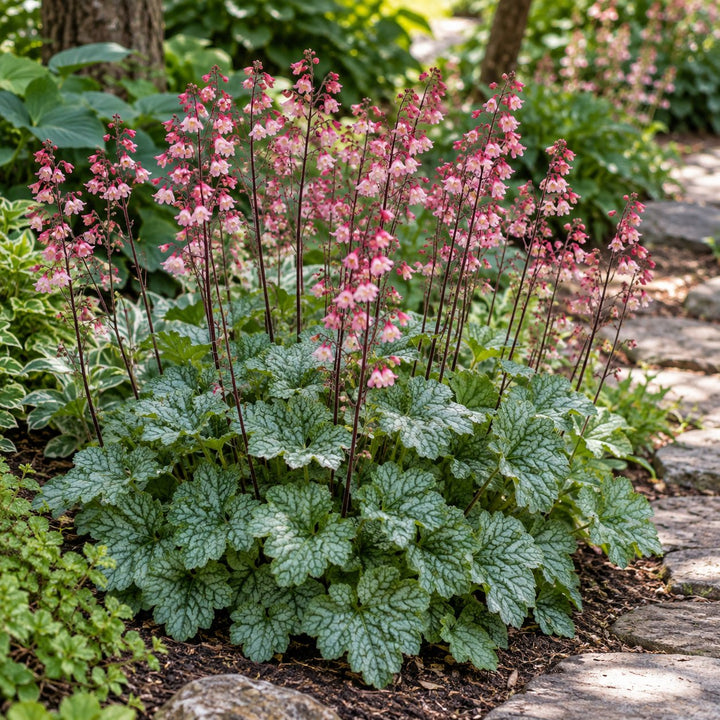
Spearmint coral bells pairs silvery green leaves and contrasting dark green veins with a long season of flowers. The foliage is a rich, deep green under the silver rather than yellow-green, with no purple undertone, so the two-tone pink blooms stand out clearly. Each tiny bell is dark pink at the tip and pale pink at the base, carried in thick crowns of wands on stems 18 to 22 inches tall.
It is a very vigorous, wide-spreading plant, up to 30 inches across, which makes it an efficient edger.
Spearmint at a glance
| Trait | What to expect |
|---|---|
| Botanical name | Heuchera 'Spearmint' |
| Foliage | Silvery green with dark green veins |
| Flowers | Bicolor bells, dark pink tips and pale pink bases |
| Size | 8 to 10 inches tall, 26 to 30 inches wide |
| Bloom | Starts early July, peaks late July, about five weeks |
| Hardiness | USDA zones 4 to 9 |
| Light | Full sun to full shade; afternoon shade best in hot sites |
| Wildlife | Great for pollinators and hummingbirds; moderately deer resistant |
Where it fits near lavender
Spearmint is not a dry-bed plant like lavender, but it is more flexible than many coral bells. In hot sites it handles sun if the soil stays evenly moist, and it is happiest with afternoon shade. That makes it a good choice for the edge of a garden where a lavender bed meets the shade of a fence, porch or tree. Its silvery leaves continue lavender's silver theme into the cooler zone, and its pink flowers bloom in July alongside the lavender.
Give it a separate strip or pocket where you can water it without wetting lavender crowns. In the shade bed proper, it mixes well with hostas, ferns and darker-leaved coral bells. The Companion Plant Planner helps sort out which plants go where.
Care notes
- Water: regular and at the base. In full sun it needs steady moisture or leaves can scorch.
- Soil: average to fertile and well drained. Crown rot in wet, heavy soil is the main risk.
- Deadheading: cut spent stems at the base to encourage a few more flowers.
- Humidity: tolerates humid summers with good air circulation; avoid overhead watering late in the day.
- Winter: reliably hardy in Michigan in well-drained soil. Freeze-thaw cycles can heave the shallow crowns, so mulch after the ground freezes.
- Spring: press any heaved plants back in and trim tattered leaves.
Cutting from the edging
The flower stems are good for cutting and add an airy, two-tone pink touch to small bouquets. Combine them with fresh lavender stems for a summer posy that brings both sides of the garden together.
Two tray sizes
Spearmint is offered as a 72-cell plug tray and a 20-cell plug tray. Choose the 72-cell tray for mass plantings and long edgings, or the 20-cell tray for fewer, larger plugs. See each product page for current availability.
Frequently asked questions
Can Spearmint coral bells grow in full sun?
It can in many gardens if the soil stays evenly moist, but afternoon shade gives the best-looking leaves in hot sites.
How wide does it get?
Up to about 30 inches across, wider than many coral bells, so space it generously.
Does it attract hummingbirds?
Yes. Its many pink bells are a draw for hummingbirds and other pollinators.

































Share how it went in your field