

Product Field NotesCompanion Plants
Sparkling Sapphires False Indigo: Vivid Blue Right Before Lavender
 Save
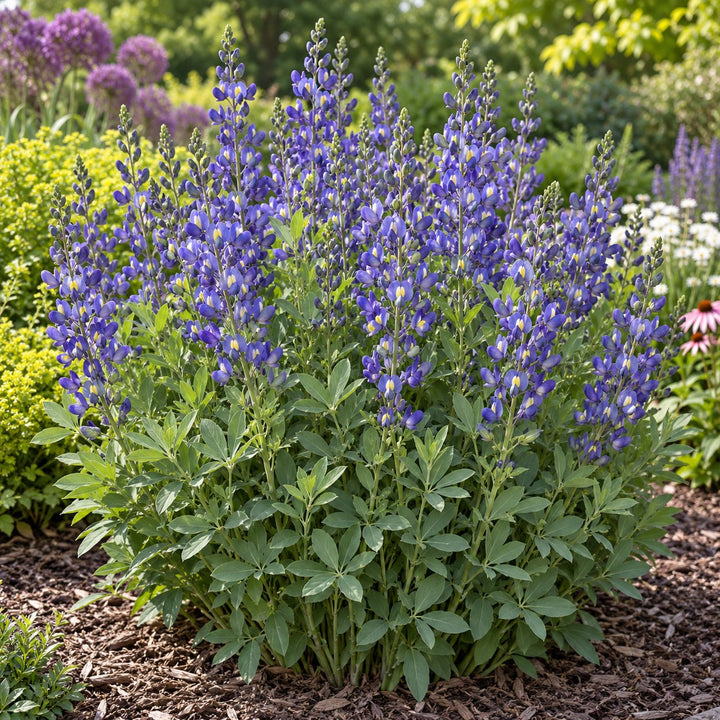
Sparkling Sapphires false indigo has some of the brightest color of any false indigo: upright, 8-inch spikes of pea-shaped flowers in intensely vivid violet blue with pale yellow keels. They open in late spring, about the time peonies bloom, over a compact, rounded mound of gray-green, three-parted leaves.
Its blue spikes arrive just before lavender's, so planting the two together gives a continuous run of blue and purple from late May well into summer.
Sparkling Sapphires at a glance
| Trait | What to expect |
|---|---|
| Botanical name | Baptisia 'Sparkling Sapphires' |
| Flowers | Vivid violet blue with pale yellow keels, on 8-inch spikes |
| Foliage | Gray-green, three-parted |
| Size | 30 to 36 inches tall and wide |
| Bloom | Starts late May, peaks early June |
| Hardiness | USDA zones 4 to 9 |
| Light | Full sun to part shade |
| Wildlife | Great for pollinators; deer resistant |
The relay with lavender
Think of Sparkling Sapphires as the opening act. It blooms in late May and early June, just as lavender buds are forming. By the time its spikes fade, lavender is coloring up, and the gray-green baptisia foliage stays handsome as a backdrop through summer. Dark seed pods form right after bloom and last into fall, adding texture behind the lavender after the harvest.
At 30 to 36 inches tall and wide, it is compact for a false indigo, easy to fit behind a row of lavender or as a single specimen at the end of a bed. Both plants share a love of sun and lean, well-drained soil. Line up the bloom timing with the Lavender Bloom Calendar and lay out the bed in the Companion Plant Planner.
Planting for the long haul
- Choose carefully: false indigo grows a deep taproot and does not like to be moved once established. Pick its permanent home at planting time.
- Be patient: it takes a couple of seasons to settle in before blooming at full strength. After that it is long lived.
- Soil: lean to average and well drained. Soggy winter soil is the main cause of loss.
- Water: once the taproot is established, it is drought tolerant. In a hot spring, individual spikes pass more quickly.
- Airflow: give it room so foliage stays clean after bloom in humid summers.
- Fall: cut stems down in late fall, or leave the dark pods standing for winter interest.
Cutting and pods
The flower spikes are good for cutting; cut when the lower flowers have opened. The dark seed pods are also useful in dried arrangements, a nice partner for dried lavender bundles in fall.
Plug tray or bare root
Sparkling Sapphires is offered as a 72-cell plug tray, suited to growers and larger plantings, and as a bare root plant for a single specimen. See each product page for current availability.
Frequently asked questions
Why has my false indigo not bloomed yet?
Young plants spend their first seasons building a deep root. Expect stronger bloom after a couple of years.
Can I move it later?
It is best not to. The deep taproot makes established plants hard to move successfully.
Is it safe to eat?
No. False indigo contains alkaloids and is considered mildly toxic if eaten. It is grown as an ornamental.

































Share how it went in your field