

Use & Care NotesCompanion Plants
Tuscan Sun False Sunflower: Golden Daisies for Lavender's Hot Spots
 Save
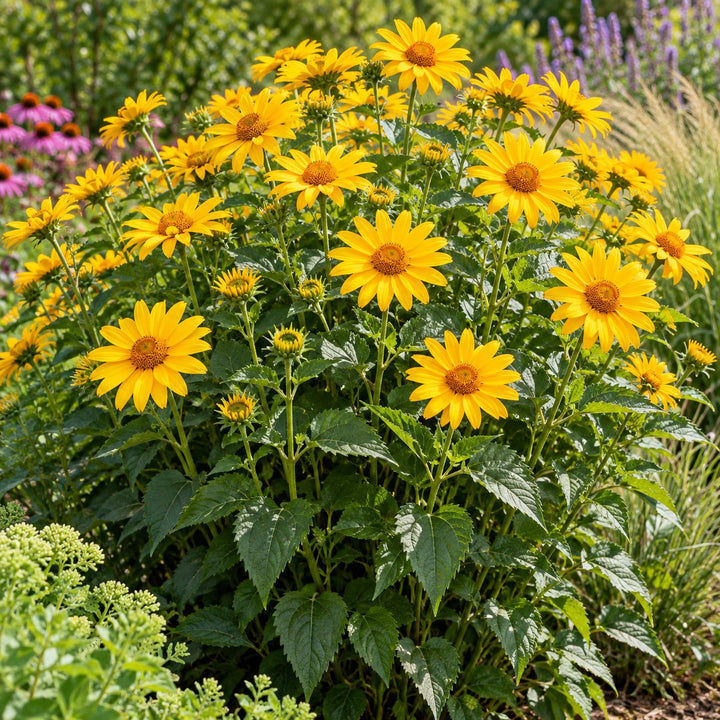
Tuscan Sun false sunflower is a compact form of a native prairie plant, with bright golden yellow daisies around domed orange-gold button centers. It flowers on strong, branched stems through the hottest weeks of summer, exactly when many perennials start looking tired.
It has earned top marks in university trial gardens, and in a lavender garden it earns its keep by doing well in the same hot, sunny ground.
Tuscan Sun at a glance
| Trait | What to expect |
|---|---|
| Botanical name | Heliopsis helianthoides 'Tuscan Sun' |
| Flowers | Golden yellow daisies, 2½ to 3 inches, orange-gold centers |
| Foliage | Glossy deep green, toothed |
| Size | 24 to 36 inches tall, 20 to 24 inches wide |
| Bloom | Starts early July, peaks late July, long blooming |
| Hardiness | USDA zones 3 to 9 |
| Light | Full sun to light part shade |
| Wildlife | Great for pollinators; moderately deer resistant |
A sunny-day partner for lavender
Purple and gold is a combination that never looks fussy. Tuscan Sun's daisies are round and flat-faced, a good contrast to lavender's slender spikes, and the glossy dark leaves set off lavender's silver foliage. Its first flowers open in early July, overlapping with the tail of the main lavender bloom, then carry on through late summer.
At up to 3 feet tall but only about 2 feet wide, it slots in behind a lavender hedge without crowding it. Leave a little air between the two so lavender mounds dry quickly after rain. Test spacing in the Companion Plant Planner.
Planting and care
- Site: full sun gives the sturdiest stems; light part shade is tolerated.
- Soil: average and well drained. Like lavender, it does not want rich, heavy soil.
- Water: water through the first season; established plants handle dry spells.
- Deadheading: snip spent flowers to stretch the season.
- Fall: cut back after frost, or leave the seed heads for birds and cut back in spring.
Powdery mildew is the most common issue, mostly in crowded, still-air spots. Red aphids sometimes cluster on stems in early summer; a strong spray of water usually moves them along.
Cutting flowers
Tuscan Sun is rated excellent as a cut flower. Cut stems when the flowers have just opened, early in the day, and they will last well in a vase. Sunflower-gold daisies with fresh lavender make a cheerful farmhouse bouquet. Plan a cutting row with the Cut Flower Planner.
Plug trays or bare root
It is offered as a full 72-cell plug tray for growers and large plantings, and as a bare root plant for gardeners who want to set a few plants directly in the border. See each product page for current availability.
Frequently asked questions
Is it a true sunflower?
No. False sunflower is a different native perennial that comes back every year, unlike the annual sunflower.
Does it need staking?
It is bred to be compact with strong, wind-tolerant stems, so staking is rarely needed in lean, sunny soil.
How cold-hardy is it?
Very. It is rated for zones 3 to 9 and needs no special winter care in Michigan.
















Share how it went in your field