

Product Field NotesCompanion Plants
Voices in the Wind Hosta: Ruffled Cream Edges on Wide Blue Leaves
 Save
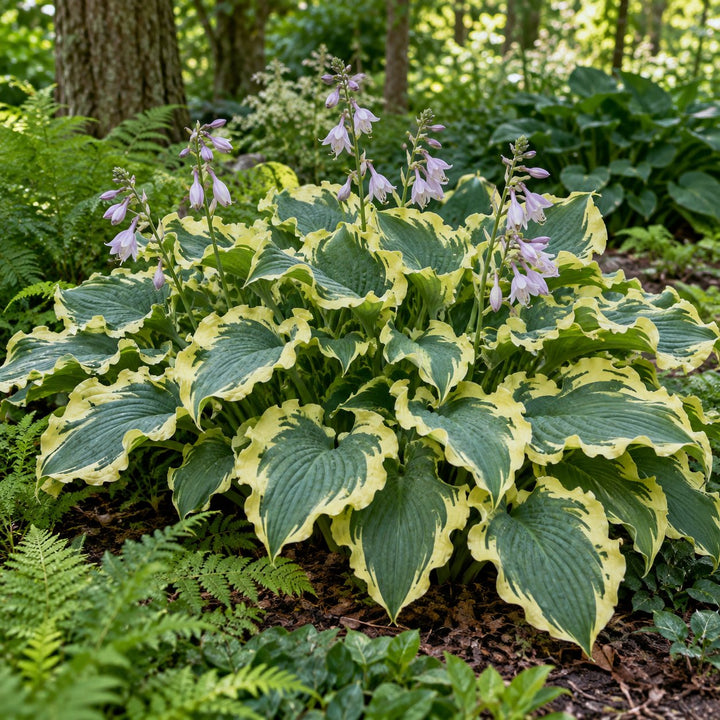
Voices in the Wind hosta has blue-green, wedge-shaped leaves with a matte, waxy surface and wide, very ruffled creamy yellow margins that ripple along the whole edge. The leaves arch outward into a broad mound about 17 inches tall and nearly 4 feet wide.
The name suits it. Planted along a path, the rippled edges look like they are moving even on a still day. That path should be in the shade, though, which means away from your lavender.
Voices in the Wind at a glance
| Trait | What to expect |
|---|---|
| Botanical name | Hosta 'Voices in the Wind' |
| Foliage | Blue-green with wide, very ruffled creamy yellow margins |
| Flowers | Pale lavender trumpets on 24- to 29-inch scapes |
| Size | About 17 inches tall and 46 inches wide |
| Bloom | Mid-July into early August |
| Hardiness | USDA zones 3 to 9 |
| Light | Part sun to part shade, full shade |
| Wildlife | Attracts hummingbirds; deer browse it |
Planning around lavender
Lavender and hostas are both easy plants, just not in the same spot. Lavender needs hot sun and dry, lean soil; Voices in the Wind needs shade and steady moisture. Most properties have room for both. A typical layout puts lavender along the sunny front of the house and a shaded walk under trees in back, lined with this hosta, ferns and astilbe.
The two connect through color. Voices in the Wind sends up pale lavender flowers from mid-July into early August, after the main lavender bloom, so there is still lavender-colored bloom in the garden while you are drying your harvest. Its blue-green leaves also share the cool tone of lavender's foliage. Sort out sun and shade in the Companion Plant Planner.
Getting the most from the ruffles
- Light: blue-green color is best in shade. Hot afternoon sun can scorch the cream margins.
- Spacing: it grows nearly 4 feet wide, so give it room. Crowding hides the arching shape.
- Massing: a line of three or more along a walk shows off the rippled edges best.
- Containers: a wide pot in a shaded spot lets the leaves arch over the rim.
Care through the year
Plant in rich, humus-heavy soil and water deeply during dry spells, especially the first summer. Cut spent scapes after bloom. After a hard frost, cut the foliage down to remove slug eggs and debris, and keep the crown in soil that does not sit wet over winter. Divide crowded clumps in early spring as shoots emerge.
Slugs are the main pest in wet years. Also watch for mottled, streaked leaves, a sign of Hosta Virus X; discard any affected plant.
Formats offered
It comes as a full 72-cell plug tray and as a deep 20-cell plug tray. The 72-cell tray suits growers and mass plantings; the 20-cell tray offers fewer, larger plugs. See each product page for current availability.
Frequently asked questions
Are hostas safe around pets?
Hosta foliage is listed as toxic to dogs and cats, so plant it where pets will not chew it.
Do the margins stay creamy yellow?
They are creamy yellow and ripple along the whole leaf edge. Shade keeps them from scorching.

































Share how it went in your field