

Product Field NotesCompanion Plants
Whitecaps Stokes' Aster: Fringed White Discs for Late Summer
 Save
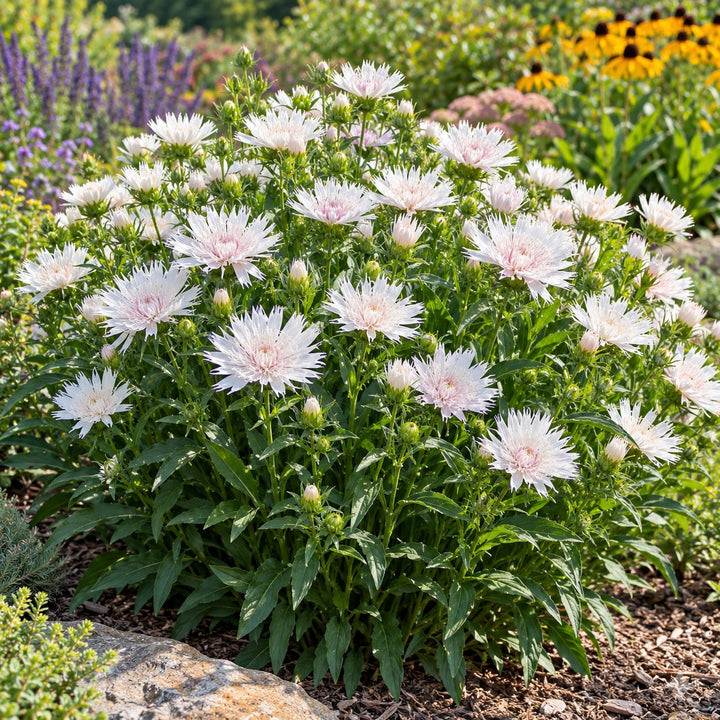
Whitecaps Stokes' aster forms a dense, well-branched clump of rich dark green leaves topped with flat, cornflower-like flowers 2.5 to 3 inches across. They are near white with a very faint blush of pink or lavender, and from a distance they read as clean white, each with an outer ring of fringed petals around a finely cut center.
Strong branching from the base produces a heavy crop of blooms, and the plant handles heat and humidity with ease.
Whitecaps at a glance
| Trait | What to expect |
|---|---|
| Botanical name | Stokesia laevis 'Whitecaps' |
| Flowers | Near white with a faint pink blush, fringed, 2.5 to 3 inches |
| Foliage | Long, smooth, rich dark green |
| Size | 24 to 26 inches tall, 32 to 36 inches wide |
| Bloom | Starts mid-July, peaks early August, into early fall |
| Hardiness | USDA zones 5 to 9 |
| Light | Full sun |
| Wildlife | Great for pollinators and butterflies |
Carrying the color past harvest
Lavender's big moment is early summer. By August most lavender has been cut and the bed is all foliage. Whitecaps fills that gap: it begins in mid-July, peaks in early August and keeps going into fall with deadheading. Stokes' asters come in the same purple, blue and white tones as lavender, so a white one keeps the lavender color theme going through late summer.
The two share a love of full sun and well-drained soil, and Whitecaps adapts to poor or fertile ground and handles some dryness. Its broad mound, close to 3 feet wide, works as a filler between groups of lavender or along the front of a large bed. Leave space so neither plant crowds the other. Try layouts in the Companion Plant Planner.
Planting and care
- Site: full sun. It is a heat-loving native of the Southeast and keeps blooming through hot summers.
- Soil: well drained above all. Crown and root rot in wet winter soil is the main problem.
- Deadheading: remove spent flowers to keep new buds coming into early fall.
- Winter: in colder areas, mulch lightly after the ground freezes. Leave the basal rosette in place over winter.
- Spring: clean up dead leaves as new growth starts.
It has few diseases besides crown rot and occasional leaf spot. Good air flow keeps the foliage cleaner in humid weather.
For cutting and containers
Whitecaps is rated good as a cut flower and is also listed for containers. A few fringed white discs make late-summer bouquets feel fresh, and they mix well with dried lavender from earlier in the season.
About the plug tray
It is offered as a full 72-cell plug tray, a good fit for native gardens, pollinator plantings and larger borders. See the product page for current availability.
Frequently asked questions
Is it pure white?
It reads as white from a distance, with a very faint pink or lavender blush up close.
Will it survive a Michigan winter?
It is rated for zones 5 to 9 and is hardy in zone 5 Michigan gardens when the soil drains well. A light mulch after the ground freezes helps in colder spots.

































Share how it went in your field