

Use & Care NotesCompanion Plants
White Wands Spike Speedwell: Long-Blooming White for Midsummer
 Save
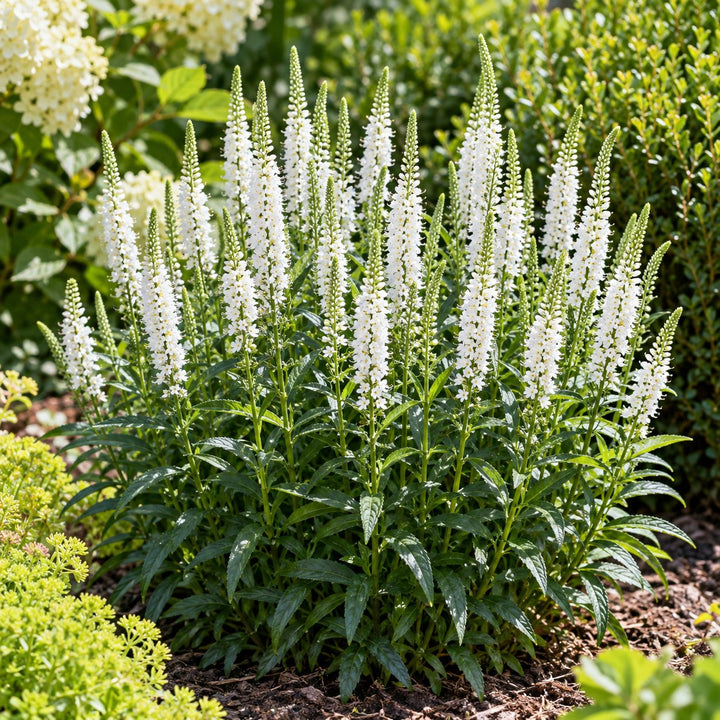
White Wands spike speedwell is one of the longest-blooming speedwells, carrying slender, tapering spikes packed with tiny pure white florets over a compact clump of dark green, glossy, narrow leaves. It flowers from midsummer into late summer and often sends up more spikes in September, well after other speedwells have quit.
The flowers are self-cleaning, and the glossy foliage holds its lower leaves well into the season, so the plant looks tidy without much fuss.
White Wands at a glance
| Trait | What to expect |
|---|---|
| Botanical name | Veronica 'White Wands' |
| Flowers | Pure white, slender tapering spikes |
| Foliage | Dark green, glossy, narrow |
| Size | 14 to 16 inches tall, 16 to 20 inches wide |
| Bloom | Starts early July, peaks late July, often more in September |
| Hardiness | USDA zones 4 to 8 |
| Light | Full sun to part shade |
| Wildlife | Excellent for bees, butterflies and hummingbirds; deer resistant |
After the lavender peaks
White Wands opens in early July and peaks in late July, so it overlaps the tail of the main lavender bloom and then takes over once the lavender is harvested. That matters in a lavender garden, where the beds can look a bit bare in August after the stems are cut. A row of white spikes keeps the spiky texture going and makes the regrowing lavender mounds look neat beside it.
At 14 to 16 inches, it fits in front of taller lavender or behind very low edgers. The dark, glossy leaves are a nice change from lavender's matte silver, so the planting does not look like one big gray mass.
The one difference to plan for
Speedwell likes full sun like lavender but wants a little more moisture and does not want soil that stays dry for long. In hot, dry spells bloom slows and the lower leaves may brown. The fix is placement: set it at the outer edge of the bed, where a hose reaches it easily without soaking the lavender crowns. Sketch that edge in the Companion Plant Planner.
Care through the season
- Deadheading: trim spent spikes back to the next set of side buds to encourage more side shoots.
- Water: a deep drink in dry spells keeps it blooming.
- Air flow: space plants to reduce powdery and downy mildew in humid weather.
- Winter: well-drained soil prevents crown rot. Cut back spent stems in fall or early spring.
- Dividing: split crowded clumps every few years in spring.
Containers and cutting
Its compact size suits containers, and the spikes are good for cutting. White Wands with fresh lavender is an easy, classic bouquet. Plan a cutting bed with the Cut Flower Planner.
Formats offered
White Wands is offered as a full 72-cell plug tray for growers and borders, and as a bare root plant for adding a few to a home garden. See each product page for current availability.
Frequently asked questions
What does self-cleaning mean?
Spent florets drop on their own instead of hanging on and browning, so the spikes look clean longer.
How is it different from Very Van Gogh?
Both are long-blooming spike speedwells. White Wands is a bit shorter with white flowers and glossy leaves; Very Van Gogh has rosy purple, heavily branched spikes.
















Share how it went in your field