Savings apply automatically in your cart. Not combined with wholesale pricing.
Re-stocking soon
Live plant delivery check
Where will this plant go?
Five quick steps confirm delivery, growing needs, protection, and the final order path.
Step 1 of 5 · Delivery method
First, choose delivery
How would you like to receive your plants?
You can switch between shipping and farm pickup later.
Location and timing
Where should we check delivery?
We can reuse a ZIP from another GLLF zone tool, your saved delivery choice, or your customer account. You may replace it for this destination.
Your location does not affect farm pickup.Choose an available Wednesday or Friday, 10:00 AM–3:00 PM Eastern. We will confirm that your plants are ready.
Your saved delivery plans
Reuse fulfillment, destination, date, and growing answers. Optional protection is never copied.
Try another option
If plants in pots or plugs cannot ship to your state, your plant and quantity stay saved. Choose farm pickup, enter another delivery ZIP, or shop soil-free bare root plants during their March 1–May 31 shipping window.
We recommend purchasing 6 months in advance to secure your space in the greenhouse. Most of our plants are grown to order, so they can take up to 6 months to fill out with good roots for planting. Earlier dates are welcome if we already have the plants growing in our greenhouse — we'll confirm timing with you. Dates within 30 days must be paid in full. Dates 31 days or more out require a 50% deposit, with the balance due two weeks before we ship.
Growing plan
Where will the plant live?
This helps us explain hardiness and seasonal care. You can change the answer for any plant.
Protection
Choose the protection that fits
Your included arrival coverage appears first. Optional plans are never required to buy this plant.
Loading the protection choices…
💜 Plant reservation
Your plants
Add every cultivar and size first. When finished, continue to secure payment. Production begins only after farm approval; denied orders are refunded.
Use one delivery plan for this reservation
No plants are waiting in this reservation yet.
🛡️
Live plant protection
Choose coverage for this shipment
24-Hour Healthy Arrival
Server confirmation pending for this shipment.
Pending
Bare root arrives dormant
Expect new growth in 6 to 8 weeks after planting. Until then it can look lifeless, so you won’t be able to tell within 24 hours of arrival whether it will grow.
For coverage after arrival, consider adding the optional 1-Year Grow Guarantee below. Terms
Optional paid protection
Prices come from a secure quote for this exact plant, quantity, route, date, destination and weather decision. You may continue without either plan.
Complete the delivery review to check optional protection.
🎓 Care Academy
One free step before checkoutYour 1-Year Grow Guarantee includes our free Plant Care Academy. Keep going with your order — it just needs to be completed before checkout, and your cart will remind you.
At 32°F or below, or above 90°F, weather-dependent programs are not available for that shipment. Exactly 90°F is advisory and may remain eligible. Your plant purchase remains available when every non-weather requirement qualifies.
Qualifying server-confirmed historical weather is honored for far-future dates and live-weather failures. Browser history is guidance only and cannot authorize a paid plan or price.
Couldn't load pickup availability
Wholesale Buying Hub
Build your Wholesale reservation
Start with Bit of Honey False Sunflower - Bare Root Plant, mix qualifying varieties,
track minimums and pricing, and coordinate future production in one place.
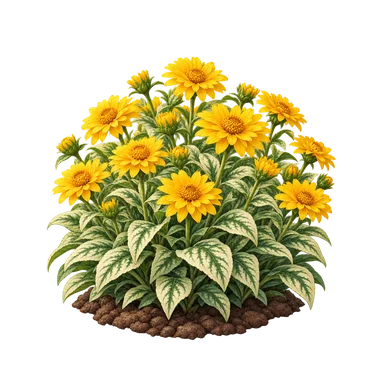
Bit of Honey is a variegated false sunflower with striking leaves that look white laced with deep green veins. On top of that foliage it carries golden yellow, semi-double flowers 3 to 3½ inches wide from midsummer into early fall.
It stays lower and denser than most false sunflowers, making it useful in the middle of a border or as a stand-alone accent. The flowers draw butterflies and bees and make good cut stems.
What it looks like
Semi-double daisy flowers 3 to 3½ inches across with several rows of golden yellow petals around a raised golden cone. Flowers are held on branched stems above the foliage. Leaves are triangular to oval with toothed edges, creamy white with a network of deep green veins, giving a marbled look. The plant is a low, dense, bushy mound 24 to 28 inches tall and 26 to 30 inches wide. At peak bloom golden flowers dot the top of a bright white-and-green mound.
Growing it with lavender
Its golden flowers contrast with purple lavender, and the white-veined leaves pick up lavender's silvery tones in the same sunny bed.
Care
Grow in full sun to light part shade in average, well-drained soil; it tolerates dry spells once established. Hardy in zones 4 to 9. Deadhead to keep flowers coming, and cut back any shoots that revert to plain green.
At a glance
Botanical name: Heliopsis helianthoides
Flower color: Golden yellow
Foliage: White with deep green veins
Growth habit: Low, dense, bushy mound
Mature size: 24–28 in tall × 26–30 in wide
USDA hardiness zones: 4–9
Light: full sun, part sun to part shade
Bloom start: Early-July
Peak bloom: Late-July
Bloom pattern: Long Blooming
Deer resistance: Moderately resistant
Pollinator value: Great
Sizes and shipping
Dormant bare-root plant, sold in boxes of 25 per variety (order in multiples of 25). Bare-root plants ship or are picked up March 1–May 31 only. They are soil-free, so they may ship to every state in that window. Dormant plants often show little or no top growth on arrival; plant or heel them in promptly.
Your reaction votes in that category and also adds one equal point to the photo's overall Lavender Crown total.
💜Community FavoriteThe photo you simply love most
📷Best ViewThe strongest composition, setting, or scene
🌱Healthiest VigorStrong visible growth for the plant's age and season
✨Creative GrowingAn inventive pot, trellis, landscape, bed, or field
Category accolades: the photo leading each emoji earns that badge; one photo can earn several. Overall Lavender Crown: all four emoji counts combine, and the highest monthly total wins. Monthly counts restart, but approved photos stay enrolled. Cultivar-confidence votes are separate.
🛡 Automated upload checks, permissions, community confidence, and vote integrity protect each entry.
Mature height
28.0 in
Mature spread
30.0 in
Bloom
Early-July – peak Late-July
Fragrance
None
Deer
Moderately resistant
Lavender companion · grow guide
How to grow Bit of Honey
False Sunflower · Heliopsis helianthoides
False sunflower wants full sun and average, well-drained soil. It's a tough native that blooms from early summer into fall and handles heat, drought and poor soil.
Free to play in your browser. Opens in a new tab, so your cart stays right here.
Full sunLight
Moderate waterAverage drainage
pH 5.5–8.0Soil
Zones 4a–9bHardiness
28″ tall30″ wide
ResistantDeer · rabbits resistant
Not known toxicPets
Huckleberry saysTell me where you grow and I’ll check if Bit of Honey will thrive there.
34567891011
Hardy in zones 4a–9b
Spring or early fall.
Your year with Bit of Honey
JFMAMJJASOND
When it arrives
Your bare-root plant
Arrives as a clump of fibrous roots with a crown of small reddish or green buds and old cut stems. Soak 20–30 minutes, plant crown at soil level, water in and keep moist until shoots appear.
Expect new growth in 6 to 8 weeks after planting. Bare root ships March–May while dormant, with little or no top growth, and it can look lifeless until then. That’s normal. Shoots appear in mid-spring, often with dark, reddish new leaves on variegated or dark-leaf types. Growth is quick once soil warms.
You won’t be able to tell within 24 hours of arrival whether a dormant plant will grow.
When to plant
Spring or early fall.
How deep
Set the crown level with the soil surface, buds just at or below the surface.
Spacing
About 2–3 ft apart; taller cultivars need the most room.
Soil
Average loam; tolerates clay, sand and poor soils · pH 5.5–8.0
Fix-it tip: No special amendments needed. In very rich soil it grows tall and floppy; lean soil keeps it sturdy.
Sun
Full sun (tolerates part sun).
In shade, stems get weak and floppy.
Dormant→New growth
Don’t give up on it
Is it alive? What spring looks like
Shoots appear in mid-spring, often with dark, reddish new leaves on variegated or dark-leaf types. Growth is quick once soil warms.
Spring
Cut back old stems; pinch or trim tall types in late May.
Summer
Long bloom; deadhead.
Fall
Leave seed heads for birds.
Winter
Leave stems standing.
Watering
First season: Water deeply weekly the first summer.
After that: Tolerates dry soil once established; water in long droughts to keep it blooming.
Feeding
Usually none needed. A light compost layer in spring is plenty.
Pruning & deadheading
Deadhead to extend bloom. Cutting stems back by about a third in late May makes shorter, sturdier plants. Leave seed heads for birds in fall, or cut back to limit self-sowing.
Dividing
Every 3–4 years in spring when the center thins.
Winter
Hardy to about zone 3. Leave stems standing for birds; cut back in spring.
Summer heat
Takes heat and humidity. Taller types may need staking or a midsummer trim.
Tall stems flop in rain
Likely cause: Rich soil or shade
What to do: Cut back in late May; stake tall types; give full sun.
Clusters of small insects on stem tips
Likely cause: Aphids
What to do: Spray off with water or use insecticidal soap.
Seedlings popping up around the bed
Likely cause: Self-sowing
What to do: Deadhead before seed sets, or pull seedlings in spring.
Too wet or too dry?
Wilting and crisp lower leaves: too dry. Yellow, rotting stems at the base: soggy soil.
Watch for
Aphids
Powdery mildew in crowded beds
Few serious problems
Pets & wildlife
Not listed by ASPCA; no known toxicity reported. Discourage pets from chewing any garden plant.
Deer: resistant · Rabbits: resistant
Finnegan saysStill not sure what’s wrong? Ask Plant Health — describe it or add a photo.
In a container
Good in pots · 3 gallon+
Compact cultivars work in large pots; water more often than in the ground.
Indoors
Outdoor plant
Needs full sun and winter dormancy outdoors.
Winter chill
No chill needed
Usually blooms the first summer; established plants bloom more heavily.
Growing it on
Dormant bare root, soaked and planted
Or a 1–2 gallon pot if the ground isn’t ready
Garden bed or a 3 gallon pot
Time to move up? Slide the plant out: if white roots wrap the outside of the soil, it’s ready for the next size.
Planting with lavender
Plant it near your lavender
Shares full sun and tolerates dry soil, but it's taller and lusher. Plant it behind or beside the lavender bed so gold daisies back up purple spikes without shading them.


 Lavender companion · grow guide
 Game card
 Game wiki

















