

Product Field NotesCompanion Plants
Bouquet Perfect™ Violetta Primrose: Lavender Tones for the Shade
 Save
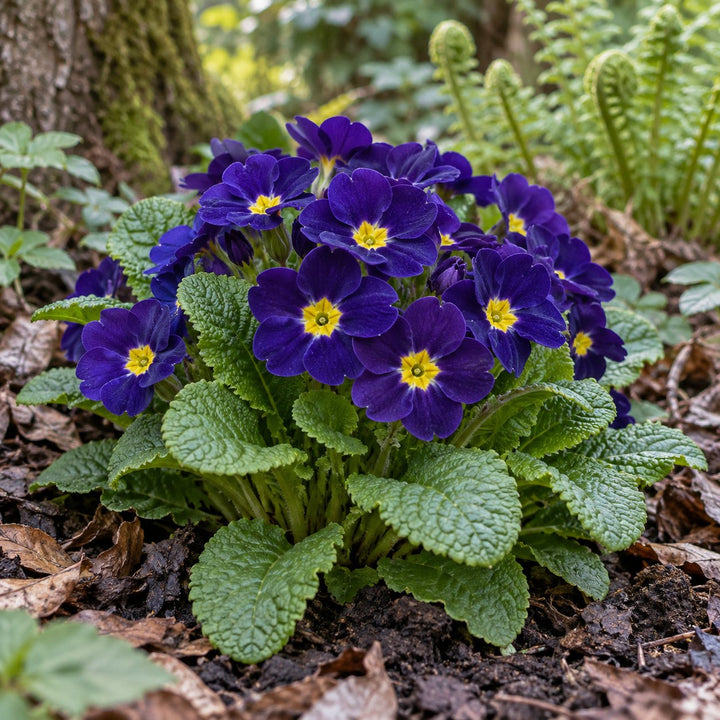
Bouquet Perfect™ Violetta primrose has some of the darkest flowers you will find in spring: very deep violet-blue petals around a small yellow eye. At peak bloom the crinkled green leaves almost disappear under a dome of dark violet, like a tiny bouquet set on the ground.
If you love the color of lavender but have a garden with real shade, Violetta is a way to carry that purple tone into places lavender could never grow. It needs cool shade and steady moisture, so it belongs on the shady side of the property.
Violetta at a glance
| Trait | What to expect |
|---|---|
| Botanical name | Primula vulgaris Bouquet Perfect™ Violetta |
| Flowers | Very dark violet-blue with a yellow eye, about 1.5 inches across |
| Size | 5 to 8 inches tall, 10 to 12 inches wide |
| Bloom | Early through late April |
| Hardiness | USDA zones 4 to 8 |
| Light | Part sun to part shade, or full shade |
| Deer | Moderately resistant |
Purple in two seasons
A garden built around lavender can tell one color story from spring to summer. Violetta opens the season in April in the shade beds. By June, the lavender in the sunny beds picks up the same purple theme. The two never share soil, but they share a palette, and the whole property feels planned.
Because its flowers are so dark, Violetta shows best against something light. Plant it beside pale yellow or white primroses, next to emerging silver or chartreuse foliage, or at the front of a shaded bed where the light falls on it. In a container by the door, pair it with a light-colored primrose so the dark blooms do not fade into the shadows. Lay out sun and shade beds together in the Companion Plant Planner.
Keeping it happy
- Soil: humus-heavy, evenly moist, never waterlogged.
- Deadheading: pick off faded flowers. The blooms are sterile, so the plant spends its energy on new flowers instead of seed.
- Summer: keep watering through July and August. Primroses dislike heat and may go semi-dormant.
- Fall: plant by early fall so roots settle, and add a light leaf mulch in exposed spots to prevent frost heaving.
- Dividing: after bloom every few years when clumps get crowded.
Watch for slugs, aphids and spider mites, and space plants so gray mold does not set in during warm, muggy weather.
Ordering format
Violetta is offered as a 72-cell plug tray. See the product page for current availability.
Frequently asked questions
Is Violetta the same purple as lavender?
It is darker, a deep violet-blue rather than lavender's lighter purple, but the two sit in the same color family.
Can it grow in full sun?
Not well. Sun and dry soil stress primroses, especially in summer. Keep it in shade.
Is it fragrant?
It has a mild fragrance. The scent you plan a garden around is still the lavender's.

































Share how it went in your field