

Product Field NotesCompanion Plants
Daisy May® Shasta Daisy: A White Dome for Cottage Lavender Beds
 Save
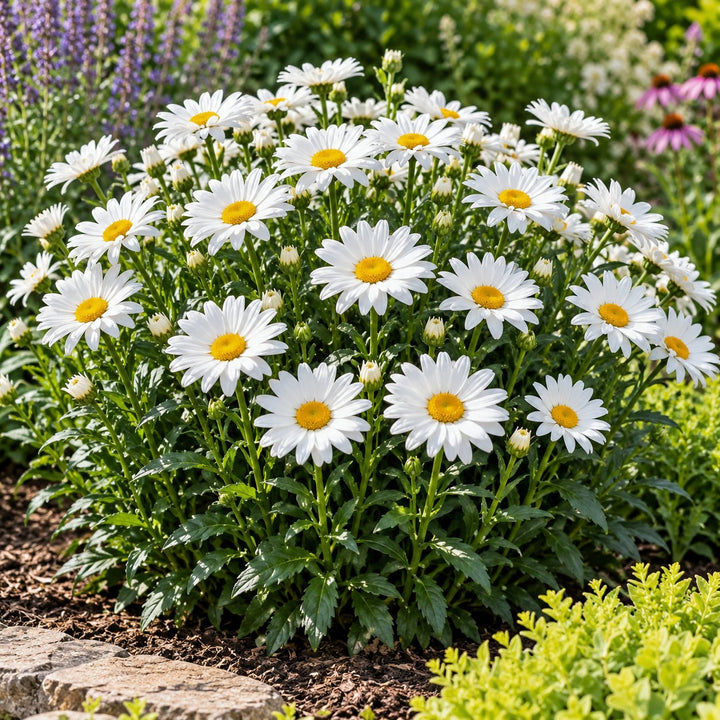
Daisy May® shasta daisy blooms so heavily that its 3-inch white flowers overlap and touch, forming a solid dome that nearly hides the glossy dark green leaves. Each flower has pure white petals around a gold button center, the picture-book daisy, held on short, sturdy stems.
Put it next to purple lavender and you have the cottage-garden look in two plants.
Daisy May at a glance
| Trait | What to expect |
|---|---|
| Botanical name | Leucanthemum × superbum 'Daisy Duke', sold as Daisy May® |
| Flowers | Single, 3-inch, pure white with golden centers |
| Foliage | Glossy dark green, toothed |
| Size | Listed from 12 to 24 inches tall; often about 20 to 24 inches in the Midwest. Check the listing for the current size |
| Bloom | Starts mid-June, peaks early July, longer with deadheading |
| Hardiness | USDA zones 5 to 9 |
| Light | Full sun |
| Deer | Moderately resistant |
Why white daisies flatter lavender
Purple can look heavy on its own in a big bed. Crisp white breaks it up, makes the lavender read as more purple, and keeps the planting looking fresh at dusk, when white flowers seem to glow. Daisy May opens in mid-June and peaks in early July, landing right on top of English lavender bloom.
Its compact dome is what makes it work. Older, taller shasta daisies flop over neighbors; this one stays upright and rounded, so it can sit between lavender groups without leaning into them. Plant it in small drifts or as a repeating dot of white along a long lavender row. The Companion Plant Planner helps you set the rhythm.
Care through the season
- Soil: average and well drained. It handles slightly richer soil than lavender, so the outer edge of the bed suits it well.
- Water: give it a drink in dry spells, especially in extreme heat, but avoid soggy ground.
- Deadheading: snip spent flowers back to a bud or leaf to stretch the bloom.
- Fall: cut flowering stems down and leave the basal leaves in place.
- Every few years: divide in spring to keep clumps vigorous.
Wet, heavy soil in winter causes most losses through crown rot, so drainage matters here just as it does for lavender. Watch for aphids and four-lined plant bugs on the leaves in early summer.
For the vase
Daisy May rates well as a cut flower. Cut stems when flowers are fully open, strip the lower leaves and change the water often. A handful of white daisies with fresh lavender stems makes an easy farmhouse jar for the table. Plan a cutting row with the Cut Flower Planner.
Daisy May is offered as a full 72-cell plug tray, a good size for mass plantings and cutting gardens. See the product page for current availability.
Frequently asked questions
Is Daisy May the same as Daisy Duke?
Yes. Daisy May® is the trademark name it is sold under; 'Daisy Duke' is the registered cultivar name.
Do the flowers smell?
No notable fragrance, which is handy if you want the lavender to be the only scent in a bouquet.
Will it grow in a container?
Yes. Its compact dome suits large containers in full sun with a free-draining mix.

































Share how it went in your field