

Use & Care NotesLavender Plants
Marshwood Lavender: A Tall Spanish Lavender in Dusky Tones
 Save
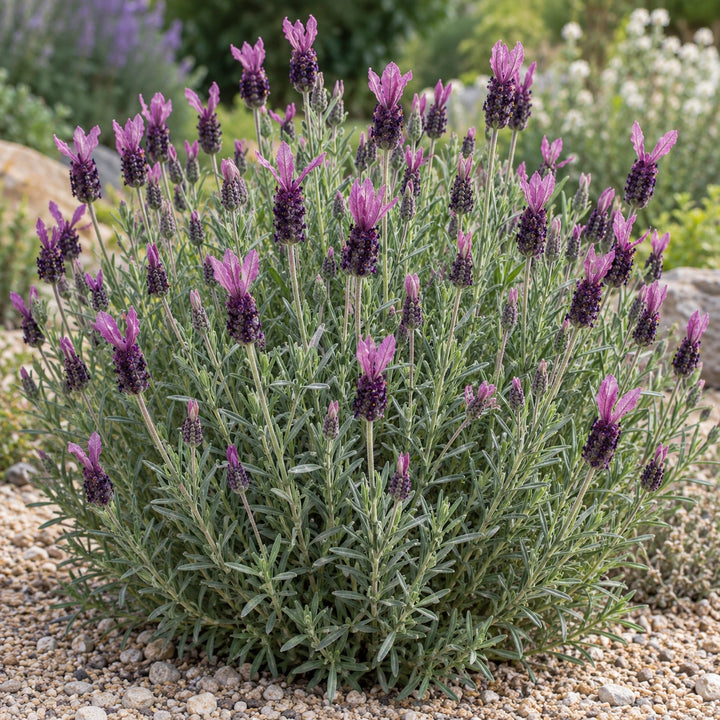
Marshwood lavender is a Spanish lavender with presence. Its flower heads are a very dark purple, crowned with dusky mauve-pink bracts, and in a mild climate the bushy plant can reach about 39 inches tall and wide. That makes it one of the larger Spanish lavenders you can grow.
The color is the draw: moody and rich up close, a soft wine shade from a distance.
Marshwood at a glance
| Trait | What to expect |
|---|---|
| Botanical name | Lavandula stoechas 'Marshwood' |
| Flower color | Very dark purple heads with dusky mauve-pink bracts |
| Foliage | Gray-green |
| Size | Up to about 39 inches tall and wide |
| Bloom | Starts early May, peaks late May, high rebloom |
| Hardiness | USDA zones 7a to 9b |
| Fragrance | Strong, resinous and herbal with eucalyptus-like notes |
| Wildlife | Great for pollinators; deer resistant |
Where a big Spanish lavender fits
In zone 7 and warmer, Marshwood can play the role of a small flowering shrub: at the corner of a sunny bed, along a gravel path or as a low informal hedge. Its size and dark color give weight to a planting, and the mauve-pink bracts tie in nicely with silver foliage, pale stone and pink or white flowers.
In colder gardens, think big pot. A large container on a sunny patio lets Marshwood show off for the season, and it can come under cover for winter. Expect a potted plant to stay smaller than one in the ground in a warm climate.
Planting and winter strategy
Use sandy, gravelly or otherwise fast-draining soil, or a gritty potting mix in a container with generous drainage holes. Plant the crown at soil level and water it in well. Give in-ground plants room to reach their full width.
With a rating of zones 7a to 9b, Marshwood is less cold-hardy than English lavender, and cold, wet soil is its greatest risk. North of zone 7, move potted plants to a cool, bright, frost-free place before hard frost and keep them on the dry side until spring. Look up your zone in the USDA Zone Finder.
Care for color all season
- Water: regularly while it establishes, then sparingly. Water needs are low.
- Deadheading: cut faded heads back to the foliage to keep new flowers coming. Marshwood has a high rebloom rating, and it rewards the effort.
- Shaping: trim lightly after each big flush. Avoid hard cuts into old wood, which may not resprout.
- Feeding: minimal. Lean conditions keep it compact and well branched.
Cutting and formats
The dark heads make striking fresh cut flowers and look especially good with silver foliage in a vase. They dry only fairly, so plan on using them fresh. Like other Spanish lavenders, Marshwood is not recommended for culinary use. Pollinators visit it heavily, and deer tend to skip it.
Marshwood is offered as 3-inch plugs, 4-inch pots and 1-gallon pots. A gallon pot is the fastest route to a big patio plant. See the product page for current sizes and availability.
Frequently asked questions
How big will Marshwood get in a pot?
Container plants stay smaller than plants grown in the ground in mild climates. Choose a wide, heavy pot and expect a good-sized mound by midsummer.
Is the color purple or pink?
Both. The flower heads are very dark purple and the bracts on top are a dusky mauve-pink, giving a two-tone look.
Can I grow it as an annual?
Yes. In colder zones many gardeners enjoy it for one season of bloom and fragrance, then replant the next spring.
















Share how it went in your field